Eagleview Eye Clinic

Archives April 2025

CENTRAL SEROUS RETINOPATHY

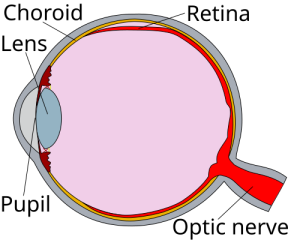
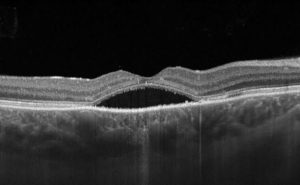
Central serous retinopathy is a condition whereby the Retinal detaches it self from the underlying tissues as a result of fluid leakages..

This condition can be as a result of stress. Stress causes an increase in the release of cortisol which triggers inflammatory responses and ultimately fluid leaks into the layers of tissues underneath the retina. Other known causes are regular use of steroid medications, autoimmune conditions.

Signs and symptoms includes, reduced vision, blurry vision, distorted vision.

Treatment is done by surgical sealing and reattaching the detached retina.
IF YOU DONT KILL STRESS, YOU MAY GO BLIND

Many people just believe that the only impact stress has over one’s health is hypertension.

Shockingly there is a whole lot of issues that can arise if one is unable to control their stress level.

The bedrock of all the issues that arise from stress is the release and increase of stress hormone, known as CORTISOL.

Increased level of cortisol in the blood is a precursor to so many issues which includes increased blood pressure, increased heart rate, diabetes…

But for the sake of our topic, we will focus on how stress affects the eyes directly.

Once cortisol is released, it triggers inflammation and leakage of fluid Under the retina. This fluid causes the Retinal to detach from the underlying tissues, causing a condition known as central serious retinopathy.

This condition requires a surgical intervention and can result in blindness if not treated urgently.

RETINAL DETACHMENT

Retinal detachment is a condition whereby the Retinal separates from the underlying tissues.

Several conditions and factors ranging from trauma, inflammation and age related degenerative conditions can result in Retinal detachment.

Signs and symptoms includes floaters, seeing dark shadows, reduced vision, blurry vision.

It can be diagnosed by the use of dilated funduscopy and other Imaging techniques.

Treatment involves reattachment surgeries like retinopexy, sclera buckling.

Prognosis depends largely on how fast treatment is carried out.

CLASSIFICATION OF LENSES ACCORDING TO REACTION TO UV LIGHT

They include:

A. WHITE LENSES: these lenses have no reaction whatsoever to uv rays. And They offer minimal protection
to radiations..

B. PHOTOCHROMIC LENSES: These lenses become shaded on exposure to UV rays. They transit back
again to their white inactive nature when they are withdrawn from the light source. They also reduce
the intensity of light that goes into the eyes of the user.

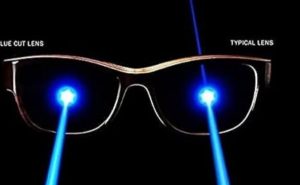
C. BLUE CUT LENSES: The types of lenses help block out harmful blue light from the sun, and digital
devices. In addition to the above property, it also possesses all the characteristics of photochromic
lenses.

TYPES OF LENSES ACCORDING TO REFRACTIVE ERROR.

These includes:

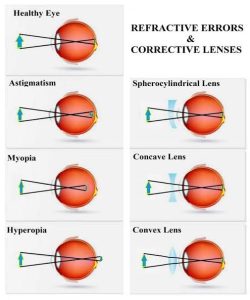
a. CONCAVE LENSES: They are known also as Minus lenses, they are used to correct shortsightedness or myopia.


b. CONVEX LENSES: They are also known as plus Minus and are used to correct hyperopia or Long sightedness.


c. CYLINDRICAL LENSES: They are lenses used to correct astigmatism.

LENS TYPES ACCORDING TO FUNCTION

These includes:

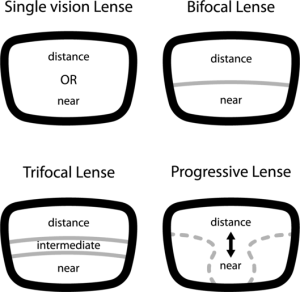
a. SINGLE VISION LENSES: These are lenses with just one power from top to botton.

b. BIFOCAL LENSES: These are lenses with two different, at the top for distance view and one below for objects close to the individual.

c. TRIFOCAL LENSES
Trifocal lenses are lenses with three powers the one at the top for distance vision, the middle one for intermediate distance and the last one below for near vision. Although it’s not really in vogue any more.

d. PROGRESSIVE ADDITION LENSES
PALs contains a myriad of optical powers from the top to the bottom. Another distinct feature of this lens is that it doesn’t posses the unsightly and visible demarcation in bifocal and trifocal. A very popular PAL brand is the varilux or varifocal lenses.

OPTICAL FRAMES

Optical Frames are supporting structures that hold the lenses. Generally frames are referred to as eyeglasses. There are different kinds of frames. Based on the type of materials used, there are plastic frames, metal frames, silicon frames, et.c

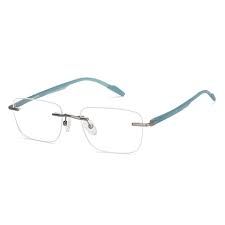
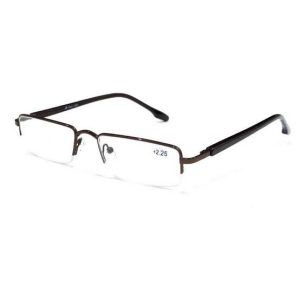
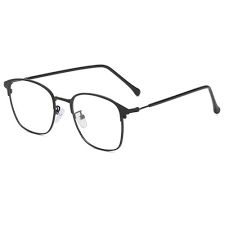
Based on the eyewear design, you can have full rimmed frame, semi rimmed and rimless frames

FULL RIMMED
These types of frames have structures that protect the lenses all round.

SEMI RIMLESS
These are frames that only offer protection halfway.

RIMLESS
These are frames that offer no protection to the lens. The lenses are held in place by screws and bots

KNOWING YOUR EYECARE PROFESSIONALS


Opthalmologist: An opthalmologist is a medical doctor whom after getting their MBBS degree in medicine, receives a residency training for another 4years to specialize in treating eye conditions majorly with drugs and surgical intervention.


Optometrist: An Optometrist is a primary Eye care professional who have received a 6 year training in Examination, diagnosis, and treatment of all kinds of eye conditions with the use of medications and glasses with the exception of surgery. An Optometrist receives a Doctor of optometry degree after they have completed their training program.


Ophthalmic nurse: An opthalmic nurse is a nurse who have received specific trainings in basic Eyecare inorder to assist the Optometrist ad ophthalmologist in patient care.


Optician: An optician is a technician who has received trainings in fitting and dispensing recommended spectacles as prescribed by the opthalmologist or Optometrist.

EYE NEVI OR EYE FRECKLES

Eye nevi or freckles is a harmless pigmented growth found on the surface of the eye ball.

A nevi is a cluster of melanin producing melanocytes. Normally they are harmless but they can eventually grow to become a cancer, if not watched.

DEMOID

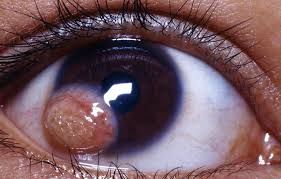
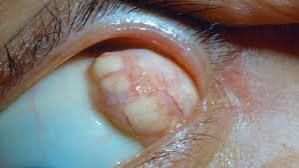
DEMOID are usually non-cancerous congenital collection of tissues found on the surface of the eyeball.

Demoid are generally harmless and can be found anywhere on the body.