Eagleview Eye Clinic

Category Eye Health Education

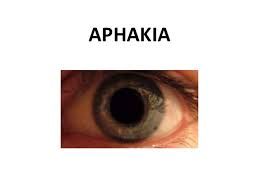
APHAKIA

This simply means the absence of crystalline lens of the eye,

Loss of crystalline lens can be as a result of surgery, cataract, penetrating injury or congenital.

People with APHAKIA find it difficult to focus on objects and they also experience very high degree of long sightedness and deep anterior chamber angle.

The crystalline is responsible for accomodations and it contribute to one third of the refractive power of the eye. So without this crystalline in place behind the iris, patients will find it difficult to focus on objects and will experience serious degree of far sightedness.
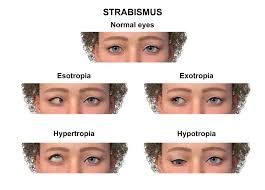
STRABISMUS

This is a disorder where by both eyes of an individual faces different positions of gaze.

This condition is also called crossed eyes,  or squint.

It is caused by injury to the eyes extraocular muscles, muscle paralysis, higher center lesions, surgery et.c.

Signs and symptoms includes visible crossed eyes, diplopia, blurry vision.

Treatment includes the use of eye patch,  eye exercises, surgery, prisms and corrective lenses.

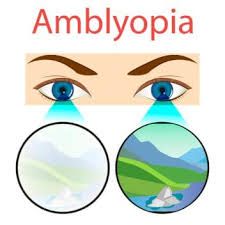
AMBLYOPIA

Amblyopia or lazy eye is a reduction in vision of one or both eyes due to poor development of vision in childhood.

In cases like this, the eye with poor vision is ignored by the brain.

Conditions that can cause amblyopia includes strabismus, refractive Errors, cataract et.c

Amblyopia is treated by each of the following techniques or a combination of all of them, use of prescription glasses, Atropization, patching, vision therapy, eye exercises et.c

AMAUROSIS FUGAX

Amaurosis fugax is a short temporary vision loss on one or both eyes, due to blockage of blood flow to the retina.

Amaurosis fugax can be a precursor of conditions that are severely sight and life threatening. Hence when complain is made, your optometrist will examine you to rule out conditions like multiple sclerosis, transient ischaemic attack, very high blood pressure, blood clots, traumatic brain injury,  stroke, optic nerve inflammation.

After Examination, treatment is instituted depending on the cause of this fleeting or transient vision loss.

EYE PATCH

Many people may or may not be familiar with Eye patch. For those who are familiar with it, but don’t know the rationale behind it, bare in mind that it may not be an Insignia or fashion item of some sort but a form of treatment.

Most eye patches are recommended by the optometrist as treatment for certain eye issues.

Some of these eye issues includes.

Amblyopia or lazy eye.

Binocular diplopia or double vision

Infection

Cornea abrasion

Strabismus/squint.

Although some eye patch are usually fashion oriented. But whenever you see someone with an eye patch, bare in mind that the person may be treating the aforementioned conditions.

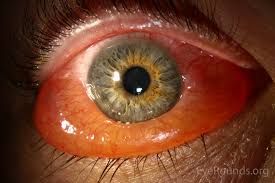
CHEMOSIS

Chemosis simply refers to the swelling of the conjunctiva, which is the thin filmed layer that coats the outer eye ball.

This swellings occurs when there’s leakage of exudates from the permeable capillaries of the conjunctiva.

Causes includes, allergies, itching, infection, HSV keratitis, trauma, surgery et.c

Treatment basically depends on the cause of chemosis

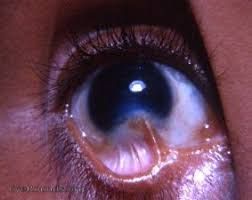
ANTERIOR STAPHYLOMA

This occurs when the sclera and uvea  undergoes thinning and then bulges out while assuming a dark blue pigmentation.

STAPHYLOMA can be caused by infection, trauma, surgery, scleritis et.c

Signs and symptoms includes, loss of vision, bulgy eyes, discharge ( for infectious cases). et.c.

Treatment is purely surgical, they include kerotoplasty, sclerokeratoplasty, mushroom grafting, et.c

SYMBLEPHARON

Symblepharon occurs when the palpebral conjunctiva adheres to the bulbar conjunctiva.

It can be partial or complete, and it can affect one or both eyes.

It is usually caused by diseases like trachoma, rosacea, cicatrical pemphigoid or even trauma.

It can be treated by symblepharectomy.

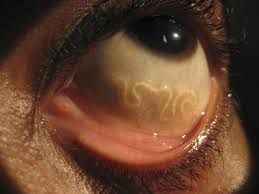
LOIASIS

Loa loa filariasis or LOIASIS is caused by the loa loa nematode.

This loa loa is known as the African eye worm as it basically localizes in the conjunctiva.

It is caused by a bite from the deer flies or horse flies. When this parasitic flies bites it’s hosts, the larvae of this worms settle in blood and lymphatic system, lungs or underneath the skin. they can stay for as long as 15 – 17 years in the host body.

This condition is most common in people residing in rainforest Africa.

Signs and symptoms includes visible worm meandering within the conjunctiva, swollen skin, itching, et.c.

This condition is not sight threatening and can be treated with drugs like ivermectin and DEC.

MACULAR HOLE

Macular hole is a break in the macular, which is the part of the retinal responsible for central vision. Macular hole can be sight threatening.

This macular hole can be shallow or full thickness.

This condition can be caused by either, INFLAMMATION like uveitis, TRACTION e.g, the vitreous, shrinking and thereby pulling on the retinal, or even TRAUMA or accident..

Signs and symptoms includes, blurry vision, distorted vision et.c

It can be diagnosed by fundsocopy, fundus photography, florescein angiography, OCT,

This condition is usually treated by surgical intervention.