Eagleview Eye Clinic
The risk of neglecting Your eye health


Have you ever gotten a comprehensive eye examination before? 
The eyes are the most essential part of the human body. Without vision, the entire body is severely impaired.

A sociologist once said “ the society is a living organism” meaning that it consists of different interdependent parts.
Similarly human body can’t function properly with a non functional eyes.

Been Blind is like been in  complete darkness, unable to see or navigate. How would you function in such a state?

You see?, it’s crucial to get your eyes checked. If you notice the slightest discomfort in the eyes, don’t wait until it gets serious- get your eyes tested immediately.

Remember, “your eyes are the window to your soul” keep them clean and healthy.

Written by Adesoji Margaret

Tags :. Eye health, Eye Examination, Functional eyes
HYPEROPIA. Far or long sightedness (causes, signs and symptoms, treatment)

Hyperopia from the two words hyper and ope meaning Excess and Eye respectively is a condition whereby an individual in most cases can see objects from afar while finding it difficult to see objects at close range.

Although there are some Hyperopic cases that does not go in line with the above definition as most hyperopes still find it difficult to see distant objects.

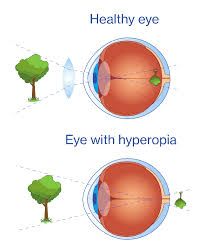
PATHOPHYSIOLOGY: normally when an individual fixates on an object, an image is formed on the retina which is then interpreted by the Brain as vision.

But Hyperopic patients usually have short eyeballs. As a result , images are formed behind the retina instead of been formed on the retina. resulting in blurry vision.

For such patients to have clear vision, they will require convex lenses to drag the image back into focus in the retina.

SIGNS AND SYMPTOMS: these includes Frontal Headache, difficulty seeing objects close to the eye,  tearing, occasional photophobia, narrow AC angle

TREATMENT: Treatment options includes use of convex lenses, LASIK surgery and finally use of contact lenses.

Tag : far sight, headache, photophobia, Vision, near sight, hyperopia

BAD FOOD CHOICES FOR THE EYES

Food is good. We all love food. But it is very sacrosanct for us to Note that just as we have healthy meal combo for topnotch visual performances, we also have very terrible food choices that grinds our eye efficiency to a halt.

Funny enough the bad stuffs even taste better and are terribly addictive because of how good they make us feel. But in the long run we are just putting a nail in the coffin of our soon to be dead eyes by consuming unhealthy food.

It is however important to note that some of the food listed below have no bad effect on  our eyes if taken in moderation.

Below are some of the food we should stay away from or reduce intake inorder to maintain perfect vision.

  1. Artificially sweetened drinks
  2. Alcohol
  3. Bread and pasta
  4. Hot dog and processed meat
  5. Canned food.
  6. Nigerian noodles
  7. Deep fried food
  8. Certain types of cooking oil

Tag :  Bad food, Healthy eyes, Eye Clinic, Eye doctor

HEALTHY FOOD FOR THE EYES

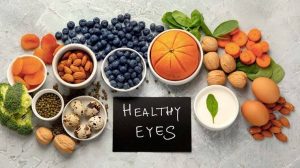
For Our eyes to maintain optimum health and function effectively, they require a myriad of Nutrients and chemicals which can either be taken as supplements or from the food we consume.

While it is cool to focus on beautiful presentation and mind blowing taste when selecting food, we should not forget to take into cognizance the nutritional value of the arrays of our food choices.

Whatever food choice you make must have a very healthy combination of vitamin A, vitamin E, lutein, xeanthin, zinc et.c

Below are some food that are necessary for optimum visual function

  1. Fruits like carrot, berries, grapes et.c which are rich in vitamin A
  2. Veggies
  3. Dairies like egg yolk, milk which are rich in lutein and xeanthin
  4. Legumes like Beans
  5. Nuts.
  6. Fish
  7. Fresh palm oil

Tag : food, healthy,   Eyes, Optimum vision

PRESBYOPIA (causes, Signs and symptoms, Treatment)

PRESBYOPIA gotten from from the Latin words Prebus and Ops meaning Old man and eye. This condition occurs when the eyes’ ability to focus on new object progressively declines. This condition starts from the late thirties to Early forties

PATHOPHYSIOLOGY: The crystalline lens in the eye is responsible for focusing on objects at various distances. At birth, the crystalline lenses are usually flexible, hence making it easy for objects at various distances to be seen clearly. But as one progresses in age, the lenses becomes thicker and more rigid, therefore it looses it’s ability to adjust to various distances. The crystalline lens for this reason can no longer focus on objects held close to the face, unless they are at a distance beyond arms length.

SIGNS AND SYMPTOMS: Difficulty seeing small objects held close to the face, headaches on prolonged near work, tearing, requiring bright lights to read, having the needs to hold reading materials faraway to read.

TREATMENT: 1. Use of bifocal Lens to aid reading. 2. Use of progressive addition lenses for reading .  3 . Use of Toric contact lenses.

Tag:      presbyopiaCrystalline lens, Reading glasses, headache, Eyecare, eye clinic, optometry.

PTERYGIUM

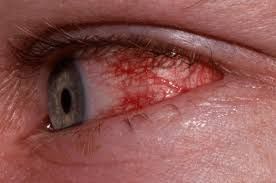
Pterygium is defined as a protective conjunctival tissue growth found on the  nasal part of the the eyeball.

PATHOPHYSIOLOGY: When the eyes are constantly exposed to irritants like dust, sunlight, particles, Dry air, smoke et.c. The body in a bid to protect the eyes stimulate a protective tissue growth to shield the eyes from unfavorable environmental conditions. This tissue growth can extend beyond the visual axis and impede vision. It can also press on the cornea thereby resulting in Astigmatism. In extreme wether conditions, this tissue growth can become inflamed, by virtue of vascular proliferation resulting in pterygitis.

SIGNS AND SYMPTOMS: reddish tissue on the nasal part of the eyeball, foreign body sensation, gritty sensation, dryness, pain

TREATMENT: This growth can be removed surgical by a procedure called PTERYGIUM EXCISION. Discomforts as a result of inflammation can be relieved by corticosteroids, Topical lubricants and NSAIDS

ALLERGIC CONJUNCTIVITIS

Allergic conjunctivitis is a compound word and this condition can be defined as the inflammation of the conjunctival tissues Triggered  by allergic reaction.

PATHOPHYSIOLOGY:  Allergic reaction occurs when the body is exposed to allergens ( unpleasant particles). This particles causes a disruption in the mast cells of the body. Once the mast cells are distabilized, protective substances known as histamines are released into the blood stream. These histamines then triggers the symptoms peculiar to allergic reactions.

SIGNS AND SYMPTOMS: signs and symptoms of Allergic conjunctivitis includes: Redness, itching, swollen conjunctiva, foreign body sensation, tearing.

TREATMENT: Treatment of allergic conjunctivitis basically involves the use  mast cell stabilizers, antihistamines, ocular decongestants and corticosteroids.

MYOPIA(SHORT-SIGHTEDNESS)

Myopia or short-sightedness is a type of refractive error where parallell rays of light coming frfom infinity are focused in front nof the retina when accommodation is at rest. Beacuse of this, the individual can only see objects that are close to him/her but not objects that are far away.

TYPES OF MYOPIA
  • Congenital Myopia; This is present from birth and is usually diagnosed by 2-3 years.
  • Developmental Myopia: This is usually present during the school going age and it’s sharpest rise occurs between 8-12 years. It is nicknamed ‘school myopia‘. It is not associated with any disease. Major causes include diet, genetics and some researchers claim excessive near work, like reading may aggravate it.
SYMPTOMS
  • Poor vision at far
  • The child may half-shut the eyelids in order to achieve greater clarity.
  • Tiredness of the eyes
  • Drowsiness

Upon examination and diagnosis of myopia by the optometrist, minus lenses are prescribed.

CATARACT

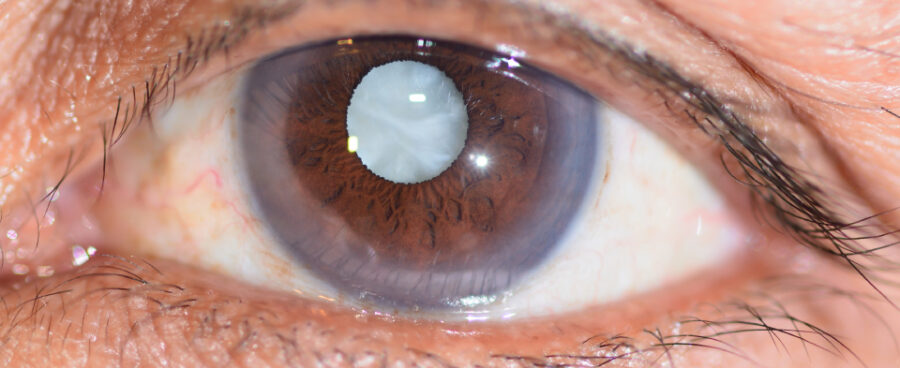
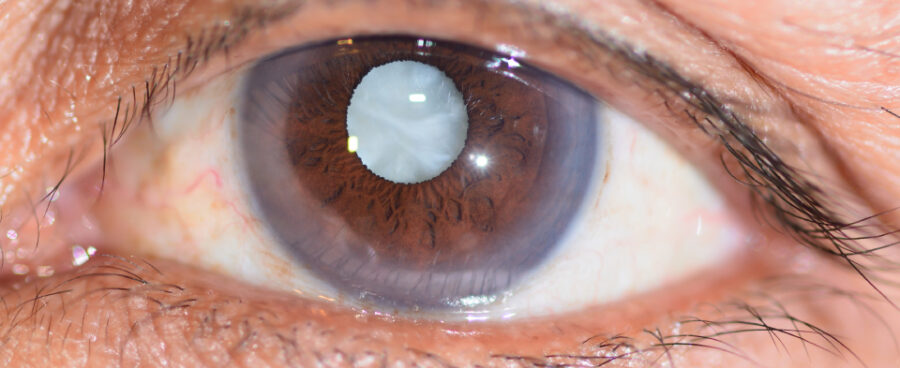
The word, ‘cataract’ dates from the Middle Ages and has been derived from the Greek word ‘katarraktes’ which means ‘waterfall’. As of today, cataract refers to the development of opacity in the lens or it’s capsule. There are so many types of cataract, classified based on it’s shape and cause. But the common types include:

  • Congenital and developmental cataract
  • Capsular cataract
  • Subcapsular cataract
  • Cortical cataract
  • Supranuclear Cataract
  • Nuclear cataract
  • Polar cataract

CAUSES OF CATARACT

They include:

  • Acquired causes e.g diabetes mellitus, drugs like steroids, miotics, etc
  • Systemic conditions like Lowe’s syndrome, osteomalacia, dwarfism, etc
  • Aging
  • Hereditary factor

SYMPTOMS OF CATARACT

  • Glare: This basically means an affected person would be extra sensitive to all sources of light,
  • Coloured halos: The affected person may complain of seeing rainbow in field of view when exposed to any light source
  • Image blur
  • Loss of vision

SIGNS OF CATARACT

The optometrist would perform the following tests:

  • Visual acuity testing
  • Ophthalmoscopy
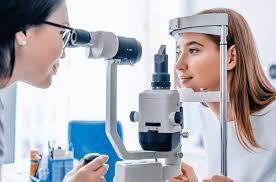
  • Slit lamp examination

Thereafter, grading is done to determine if the cataract is mature or immature.

TREATMENT

Cataracts are usually removed surgically. However non-surgical measures can also be taken, to delay it’s progression and reduce it’s symptoms. Non-surgical measures include:

  • Treatment of cause of cataract. e.g for diabetic patients, controlling blood sugar can stop the progression of cataract
  • Topical preparations containing iodide salts of calcium and potassium are instilled in it’s early stages to delay progression
  • Prescribing of lenses at regular intervals helps improve vision at different stages it’s maturity
  • Use of dark goggles in patients with central opacity provides great source of comfort outdoors
  • Mydriatics are particularly useful in patients with small axial cataract as its allows light to pass through unhindered through the now enlarged pupil, hence improving vision.
MY SIGHT….MY LIFE

The importance of a perfect vision cannot be overemphasized, considering that the options for replacement are limited. There are various causes of avoidable blindness. Research has shown that visual impairment affects the quality of life of the affected individual. This is because, he/she does not only become a liability to himself, but to his family and the nation as a whole as he/she now becomes dependent on others to fend for his/herself. If all things were equal, he should be providing for himself and even create wealth for others. Therefore, for every individual that goes blind, the economy suffers a loss. Now, this is at the national level. For his/her family members, the time and energy that would have been utilized for improvement of their own lives and finance, is dedicated to taking of the blind relative. This also affects their standard of life and general output to the economy. Sadly, blindness does not only rob the nation of the affected individual’s input, but close relatives that he/she becomes dependent on, thereby reducing the general economy of the nation.

Lastly, the visually impaired or blind individual is majorly affected, as all of his/her dreams have to be put on hold. For someone who has had a very active lifestyle, the change of pace once he/she becomes blind, may be too hard too bear. Research has shown that individuals with visual impairment/blindness tend to die quicker because they are prone to hypertension, depression, mood swings, etc.

Therefore, the importance of ensuring that one has a perfect sight cannot be overemphasized. The eye is the candle of the body. Without sight, life becomes meaningless and may even be cut short untimely. Hence the phrase, MY SIGHT……MY LIFE!!!