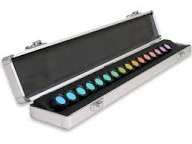
The Farnsworth D15 test is a color vision test used to assess color perception and detect color vision deficiencies. Here’s a detailed overview:
Test Procedure:
- Colored caps: The test consists of 15 colored caps, each with a specific hue.
- Arranging the caps: The patient is asked to arrange the caps in a specific order, typically in a hue sequence.
- Testing conditions: The test is usually administered in a well-lit room with good color rendering.
Purpose:
The Farnsworth D15 test is used to:
- Detect color vision deficiencies: Identify individuals with color vision problems, particularly in the blue-yellow axis.
- Assess color discrimination: Evaluate the patient’s ability to distinguish between different colors.
- Monitor color vision: Track changes in color vision over time or after treatment.
Scoring and Interpretation:
- Error score: The number and type of errors are recorded and scored.
- Color confusion index: The results are often presented as a color confusion index, which indicates the severity of color vision deficiency.
- Interpretation: The results help diagnose and classify color vision deficiencies, such as tritanopia (blue-yellow deficiency).
Applications:
- Occupational vision assessments: Used in industries where color vision is critical, such as aviation, transportation, or graphic design.
- Clinical assessments: Helps diagnose and manage color vision problems in patients.
- Research: Used in studies on color vision and its applications.
The Farnsworth D15 test is a valuable tool for assessing color vision and detecting color vision deficiencies, enabling targeted interventions and accommodations.