After a corneal foreign body is removed, you’ll typically use antibiotic eye drops to prevent infection, and maybe lubricating drops for comfort. Avoid rubbing your eye, wear sunglasses if light-sensitive, and don’t wear contacts until it’s healed. Most people feel better in 24–48 hours, but if pain, redness, or blurry vision gets worse, see your eye doctor ASAP.
CORNEA FOREIGN BODY REMOVAL
Corneal foreign body removal is a common eye procedure done when something like dust, metal, or sand gets stuck on the cornea. Here’s how it’s typically done:
- Assessment: Doctor checks eye with a slit lamp to locate and evaluate the foreign body.
- Anesthetic drops: Numbing eye drops are applied for comfort.
- Removal: Using a sterile needle, burr, or cotton swab, the doctor gently lifts out the foreign object.
- Post-care: Antibiotic eye drops or ointment are prescribed to prevent infection.
- Follow-up: Healing usually happens within 24-48 hours; pain and redness should improve quickly.
CORNEA FOREIGN BODY
Corneal foreign body: small object (metal, dust, sand) stuck on eye surface. Causes pain, redness, tearing, blurry vision, and gritty feeling. Doctor removes it with slit lamp and tiny needle or swab. After removal, antibiotic drops prevent infection, and eye heals fast—usually 24–48 hrs.

CORNEA ENDOTHELIUM
The corneal endothelium is the innermost layer of the cornea. Key features:
- Single cell layer: Composed of a single layer of hexagonal cells.
- Pump function: Maintains corneal clarity by pumping excess fluid out of the stroma, preventing edema.
- Limited regenerative capacity: Unlike the epithelium, the endothelial cells have limited ability to regenerate in humans.
- Essential for transparency: The endothelial pump function is crucial for maintaining corneal deturgescence and transparency.
The health of the corneal endothelium is vital for maintaining corneal clarity and proper vision. Damage or dysfunction can lead to corneal edema and vision loss.
CORNEA EPITHELIUM
The corneal epithelium is the outermost layer of the cornea. Key features:
- Barrier function: Protects the eye from external factors like dust, bacteria, and other foreign particles.
- Non-keratinized stratified squamous epithelium: Composed of multiple layers of flat cells that are tightly packed.
- Rapid regeneration: The corneal epithelium has a high capacity for regeneration, helping to maintain the integrity of the cornea.
- Smooth surface: Contributes to the clarity and smoothness of the cornea, essential for clear vision.
The corneal epithelium plays a crucial role in maintaining corneal health and clarity, and its integrity is vital for protecting the eye and supporting vision.
CORNEA STROMA
The corneal stroma is the thick, middle layer of the cornea, accounting for about 90% of its thickness. It’s composed of:
- Collagen fibers: Highly organized and regularly arranged collagen lamellae, which provide strength, transparency, and refractive structure.
- Kerocytes: Flattened fibroblasts scattered between the collagen fibers, involved in maintaining the extracellular matrix.
The corneal stroma’s unique structure and organization are crucial for:
- Corneal transparency
- Refractive properties
- Mechanical strength
The precise arrangement of collagen fibers in the stroma is essential for maintaining corneal clarity and function.
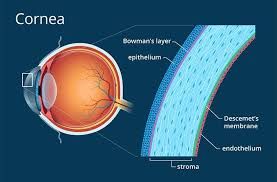
LAYERS OF THE CORNEA
The cornea, the transparent outer layer of the eye, consists of five distinct layers:
- Epithelium: The outermost layer, composed of stratified squamous epithelial cells, providing a barrier against external factors.
- Bowman’s layer: A dense, acellular layer of collagen fibers beneath the epithelium, providing strength and structure.
- Stroma: The thickest layer, composed of collagen fibers and keratocytes, making up about 90% of the cornea’s thickness.
- Descemet’s membrane: A thin, porous layer of collagen fibers produced by endothelial cells.
- Endothelium: The innermost layer, composed of a single layer of endothelial cells, responsible for maintaining corneal clarity by regulating fluid and electrolyte balance.
These layers work together to maintain the cornea’s transparency, structure, and function.
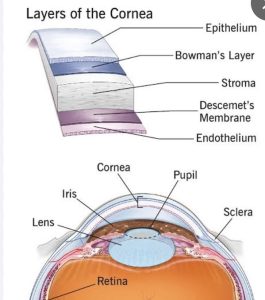
CORNEA
The cornea is the transparent, avascular (without blood vessels), dome-shaped surface at the front of the eye. It plays a crucial role in refracting (bending) light and protecting the eye.
Key characteristics:
- Transparency: The cornea is clear and transparent, allowing light to pass through.
- Structure: It consists of five layers:
- Epithelium (outermost layer)
- Bowman’s layer
- Stroma (thickest layer)
- Descemet’s membrane
- Endothelium (innermost layer)
- Function: The cornea:
- Refracts light, accounting for most of the eye’s focusing power
- Protects the eye from external damage
- Maintains the shape of the eye
- Sensitivity: The cornea is highly sensitive to touch, temperature, and chemicals.
- Nourishment: The cornea receives nutrients and oxygen from tears and the aqueous humor.
Importance: The cornea is essential for clear vision, and any damage, disease, or irregularity can significantly impact visual acuity.
DRAGON’S SPIT: Eye infection
Infection is the presence of virus, bacteria or fungus in the body.
An eye infection is a disease that affects the eye due to virus, bacteria or a fungus.
Some common eye infections are:
Cellulitis, conjunctivitis, keratitis, herpes, dacryocystitis et.c.
Some of these infections are highly contagious and need to be treated immediately to prevent them from spreading.
Can Eye Infections be Contracted?
Yes, eye infections can be contracted through various means, including:
– Touching your eyes with unwashed hands
– Sharing makeup or makeup brushes
– Not disinfecting contact lenses properly
– Coming into contact with someone who has an eye infection.
Signs of Eye Infection
How can you tell if you have an eye infection? Look out for these symptoms:
– Pain in the eye
– Increased sensitivity to light
– Colored discharge from the eyes
– Sore sensation on the iris
Can Eye Infections Lead to Blindness?
If left untreated, eye infections can cause permanent vision damage or even blindness. It’s essential to seek medical attention immediately if you experience any symptoms.
Precaution
– Visit an eye professional if you notice any signs of eye infection, such as itching, watery discharge, or vision changes.
Written by: Adesoji Margaret