Eagleview Eye Clinic

Tag Eye clinic

ORA SERRATA

The ora serrata is the serrated, anterior (front) edge of the retina, marking the transition from the non-photosensitive area of the eye to the photosensitive area. It is located near the junction of the ciliary body and the retina.

Key features:

  1. Anatomical location: The ora serrata is situated at the boundary between the retina and the ciliary body.
  2. Serrated appearance: It has a distinctive serrated or jagged edge.
  3. Transition zone: The ora serrata marks the transition from the non-photosensitive ciliary body to the photosensitive retina.

The ora serrata is an important anatomical landmark in the eye, and its location is relevant in various ophthalmic procedures and diagnoses.

LAYERS OF THE CHOROID

The choroid is a vascular layer in the eye between the sclera and retina. It consists of several layers:

1. Suprachoroid Lamina (or Suprachoroid Layer)

  • The outermost layer of the choroid, adjacent to the sclera.
  • Composed of loose connective tissue and melanocytes.

2. Choriocapillaris

  • A layer of capillaries that supplies oxygen and nutrients to the outer retina.
  • Fenestrated capillaries allow for the exchange of substances.

3. Bruch’s Membrane

  • A thin, acellular layer separating the choroid from the retinal pigment epithelium (RPE).
  • Composed of collagen and elastin fibers.

These layers work together to provide nourishment to the retina and support its function. The choroid plays a crucial role in maintaining the health and function of the retina.

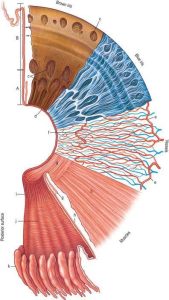
REGIONS OF THE CILIARY BODY

The ciliary body is divided into two main regions:

1. Pars Plicata

  • Location: Anterior portion of the ciliary body, closer to the iris.
  • Structure: Contains ciliary processes, which are radial folds in the ciliary body.
  • Function: The ciliary processes produce aqueous humor, which nourishes the lens and cornea and maintains intraocular pressure.

2. Pars Plana

  • Location: Posterior portion of the ciliary body, closer to the ora serrata (the serrated junction between the retina and the ciliary body).
  • Structure: This region is relatively flat and smooth compared to the pars plicata.
  • Function: The pars plana does not produce aqueous humor. It is often used as a site for surgical access to the vitreous humor, such as in pars plana vitrectomy, because it is relatively avascular (fewer blood vessels) and less likely to cause damage to other structures.

These regions are anatomically and functionally distinct, with the pars plicata being crucial for aqueous humor production and the pars plana being useful for surgical access to the posterior segment of the eye.

LAYERS OF THE IRIS

The iris consists of several layers:

  1. Anterior border layer: The front layer of the iris, consisting of fibroblasts and melanocytes.
  2. Stroma: The middle layer, composed of connective tissue, blood vessels, and melanocytes that give the iris its color.
  3. Anterior epithelium (Anterior pigmented epithelium): A layer of pigmented cells.
  4. Posterior epithelium (Posterior pigmented epithelium): A layer of densely pigmented cells that block light from entering the eye except through the pupil.

These layers work together to control the amount of light entering the eye by adjusting the size of the pupil and give the iris its color and structure.

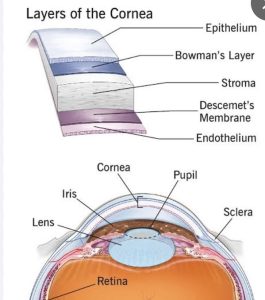
LAYERS OF THE CORNEA

The cornea, the transparent outer layer of the eye, consists of five distinct layers:

  1. Epithelium: The outermost layer, composed of stratified squamous epithelial cells, providing a barrier against external factors.
  2. Bowman’s layer: A dense, acellular layer of collagen fibers beneath the epithelium, providing strength and structure.
  3. Stroma: The thickest layer, composed of collagen fibers and keratocytes, making up about 90% of the cornea’s thickness.
  4. Descemet’s membrane: A thin, porous layer of collagen fibers produced by endothelial cells.
  5. Endothelium: The innermost layer, composed of a single layer of endothelial cells, responsible for maintaining corneal clarity by regulating fluid and electrolyte balance.

These layers work together to maintain the cornea’s transparency, structure, and function.

CHOROID

The choroid is a complex vascular layer in the eye, situated between the sclera and retina. It consists of blood vessels, melanocytes, and fibroblasts.

Key characteristics:

  1. Blood supply: The choroid is richly vascularized, supplying the retina with oxygen and nutrients.
  2. Location: It’s situated between the sclera (outer layer) and retina (inner layer).
  3. Melanin content: The choroid contains melanin, which helps absorb excess light.

Functions:

  1. Nutrient supply: Provides the retina with essential nutrients and oxygen.
  2. Waste removal: Helps remove waste products from the retina.
  3. Light absorption: The melanin in the choroid absorbs excess light, reducing scatter and improving vision.

The choroid plays a vital role in maintaining the health and function of the retina, supporting clear vision and overall eye health.

VITREOUS BODY

The vitreous body, or vitreous humor, is a clear, gel-like substance that fills the space between the lens and the retina in the eye. It:

  1. Maintains eye shape: Gives the eye its spherical shape.
  2. Supports retina: Helps keep the retina in place.
  3. Transmits light: Allows light to pass through to the retina.

The vitreous body is composed of:

  1. Water: About 99% water.
  2. Collagen fibers: Provides structure and support.
  3. Hyaluronic acid: Helps maintain its gel-like consistency.

As we age, the vitreous body can undergo changes, such as:

  1. Vitreous detachment: Separation from the retina.
  2. Floaters: Small particles that cast shadows on the retina.

Issues with the vitreous body can lead to conditions like retinal detachment or vision problems.

ZONULE FIBRES

Zonular fibers, also known as suspensory ligaments or zonules of Zinn, are tiny, thread-like structures in the eye. They:

  1. Connect the lens to the ciliary body: Zonular fibers attach the crystalline lens to the ciliary body.
  2. Suspend the lens: They hold the lens in place, allowing it to change shape for focusing.
  3. Transmit forces: Zonular fibers transmit forces from the ciliary muscles to the lens, enabling accommodation.

Zonular fibers play a crucial role in:

  1. Lens accommodation: They help change the lens shape for near or far vision.
  2. Maintaining lens position: They keep the lens centered and stable.

Dysfunction or damage to zonular fibers can lead to vision problems, such as:

  1. Lens subluxation or dislocation
  2. Vision disturbances

Zonular fibers are an essential part of the eye’s anatomy, supporting the lens and enabling clear vision.

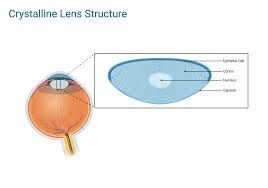
CRYSTALLINE LENS

The crystalline lens is a clear, flexible structure behind the iris and pupil in the eye. It plays a crucial role in focusing light onto the retina, enabling clear vision.

Key functions:

  1. Focusing light: The lens changes shape to focus light on the retina, allowing us to see objects clearly at varying distances.
  2. Accommodation: The lens adjusts its shape to focus on near or far objects, a process controlled by the ciliary muscles.

Characteristics:

  1. Transparency: The lens is clear, allowing light to pass through.
  2. Flexibility: The lens changes shape to focus light.
  3. Protein composition: The lens is made up of proteins and water.

Common issues:

  1. Cataracts: Clouding of the lens, affecting vision.
  2. Presbyopia: Age-related loss of near vision due to reduced lens flexibility.

The crystalline lens is a vital part of the eye’s anatomy, and its proper function is essential for clear vision.

CILIARY BODY

The ciliary body is a ring-shaped structure in the eye, located behind the iris. It’s a crucial part of the eye’s anatomy, responsible for:

  1. Aqueous humor production: The ciliary body produces the clear fluid (aqueous humor) that fills the anterior and posterior chambers of the eye.
  2. Lens accommodation: The ciliary muscles control the shape of the lens, allowing it to focus on near or far objects.
  3. Lens suspension: The ciliary body is connected to the lens via zonular fibers, which suspend the lens in place.

The ciliary body consists of two main parts:

  1. Ciliary muscles: These muscles contract and relax to change the lens shape for focusing.
  2. Ciliary processes: These are finger-like extensions that produce aqueous humor.

The ciliary body plays a vital role in maintaining the eye’s health and function, and any issues with it can lead to vision problems or eye diseases.