Eagleview Eye Clinic
HOW STRABISMUS AFFECT THE QUALITY OF AN INDIVIDUAL

👓 Strabismus can impact various aspects of an individual’s quality of life, depending on factors like the severity of the condition, age of onset, and how it’s managed.

Potential Effects on Quality of Life

  • Vision and depth perception: Strabismus can affect how well the eyes work together, potentially impacting depth perception, visual clarity, or causing double vision in some cases.
  • Self-esteem and social interactions: Especially in children or teens, noticeable eye misalignment might affect self-confidence or interactions with peers.
  • Daily activities: Depending on the severity, strabismus might impact activities like reading, driving, or tasks requiring precise eye coordination.
  • Treatment and management: Some individuals might need glasses, patches, exercises, or surgery, which can influence daily routines or emotional well-being.

Varied Experiences

  • Adaptation and coping: Many people adapt to strabismus or learn to manage its effects on their daily lives.
  • Treatment outcomes: With proper management or treatment, many individuals with strabismus lead lives with minimal impact on their overall quality of life
TYPES OF STRABISMUS

👓 Strabismus, also known as crossed eyes or squint, is a condition where the eyes don’t align properly. There are several types of strabismus based on the direction of the misalignment and other characteristics.

Types of Strabismus

  • Esotropia: One or both eyes turn inward toward the nose.
  • Exotropia: One or both eyes turn outward away from the nose.
  • Hypertropia: One eye turns upward relative to the other eye.
  • Hypotropia: One eye turns downward relative to the other eye.

Other Classifications

  • Concomitant strabismus: The amount of misalignment is the same in all directions of gaze.
  • Incomitant strabismus: The amount of misalignment varies with the direction of gaze.
  • Intermittent strabismus: The malignment occurs sometimes but not all the time.
NYSTAGMUS

Nystagmus: Key Features

Nystagmus is a condition characterized by involuntary eye movements. Key aspects include:

Characteristics

  • Involuntary movements: Rhythmic oscillations of the eyes, can be horizontal, vertical, or rotational.
  • Types: Congenital (present at birth) or acquired (develops later due to other conditions).

Causes and Associations

  • Congenital nystagmus: Often associated with conditions like albinism, low vision, or neurological issues.
  • Acquired nystagmus: Can result from neurological conditions, medications, or inner ear problems.

Symptoms and Impact

  • Vision issues: Reduced visual acuity or clarity due to eye movements.
  • Dizziness or imbalance: Some may experience these due to associated vestibular issues.

Management

  • Treatment of underlying cause: If possible.
  • Glasses or contact lenses: May help with vision correction.
  • Surgery or therapy: Sometimes considered for specific cases.

OCULAR ALBINISM

Ocular Albinism: Detailed Information

Ocular albinism is a group of inherited conditions affecting the pigmentation of the eyes. Key aspects include:

Characteristics

  • Reduced pigmentation: Mainly affects the iris and retina.
  • Vision problems: Common issues include reduced visual acuity, nystagmus (involuntary eye movements), strabismus, and photophobia (sensitivity to light).
  • Type 1 (OA1): Most common form, typically X-linked inheritance affecting males more severely.

Symptoms and Effects

  • Visual impairment: Range from mild to significant vision loss.
  • Nystagmus and strabismus: Common associated eye movement issues.
  • Photophobia: Sensitivity to light due to lack of pigmentation.

Genetics and Diagnosis

  • Inheritance: Usually X-linked for OA1, affecting males primarily.
  • Diagnosis: Often based on clinical findings like iris transillumination defects and visual issues.

Management

  • Visual aids: Glasses or contact lenses may help.
  • Low vision support: Services can assist with daily challenges.
  • Protection from sunlight: Due to photophobia.

CARUNCLE

The caruncle is a small anatomical feature of the eye. Key features:

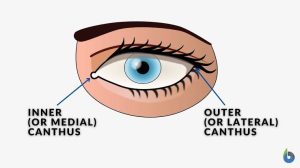
  1. Location: Located at the medial (inner) corner of the eye, in the medial canthus.
  2. Description: A small, fleshy prominence containing sebaceous and sweat glands.
  3. Function:
    • May contribute to tear film stability or eye lubrication.
    • Can be a site for potential pathology like inflammation or lesions.

The caruncle is a minor but notable part of the eye’s anatomy.

LATERAL CANTHUS

The lateral canthus is a part of the eye’s anatomy. Key features:

  1. Location: The outer corner of the eye where the upper and lower eyelids meet.
  2. Function:
    • Helps with eyelid stability and movement.
    • Contributes to the overall shape and function of the eyelids.
  3. Clinical significance:
    • Can be involved in conditions like lateral canthal tendon laxity or injuries.
    • Sometimes a focus in oculoplastic surgery for cosmetic or functional reasons.

The lateral canthus is one of the anatomical landmarks of the eye.

OPTIC RADIATION

The optic radiations are part of the visual pathway. Key features:

  1. Location: Extend from the lateral geniculate nucleus in the thalamus to the visual cortex in the occipital lobe.
  2. Function:
    • Carry visual information from the lateral geniculate nucleus to the visual cortex.
    • Help process visual data like shape, color, and movement.
  3. Importance:
    • Damage to optic radiations can cause visual field defects.
    • Lesions can lead to specific types of visual loss depending on location.

The optic radiations play a crucial role in transmitting visual information to the brain’s visual cortex.

TRABECULAE MESHWORK

The trabecular meshwork is a key structure in the eye. Key features:

  1. Location: Located near the base of the iris, in the angle of the anterior chamber.
  2. Function:
    • Drains aqueous humor from the eye
    • Regulates intraocular pressure by controlling outflow of aqueous humor
  3. Importance: Dysfunction or blockage of the trabecular meshwork can lead to increased intraocular pressure and conditions like glaucoma.

The trabecular meshwork plays a crucial role in maintaining healthy intraocular pressure.

AQUEOUS HUMOR

The aqueous humor is a clear fluid in the eye. Key features:

  1. Location: Fills the anterior chamber (between the cornea and iris) and posterior chamber (between the iris and lens).
  2. Function:
    • Maintains intraocular pressure
    • Provides nutrients to the lens and cornea
    • Removes waste products
  3. Production and drainage: Produced by the ciliary body, drained through the trabecular meshwork.

Imbalances in aqueous humor dynamics can lead to conditions like glaucoma.

GLAND OF MOLL

The Moll’s glands or glands of Moll. These are:

  1. Location: Small sweat glands located near the eyelashes, specifically in the eyelid margin.
  2. Function: They contribute to the secretion of sweat around the eye area.
  3. Clinical significance: Blockage or infection of these glands can lead to conditions like hordeolum (stye) or blepharitis.

The glands of Moll play a role in maintaining the health of the ocular surface and eyelid area.