Eagleview Eye Clinic

Tag eye doctor

OPTIC CHIASM

The optic chiasm is a part of the visual pathway. Key features:

  1. Location: Located at the base of the brain, above the pituitary gland.
  2. Function:
    • Nerve fibers from the nasal part of each retina cross over (decussate) here.
    • Allows for integration of visual information from both eyes.
  3. Importance:
    • Plays a crucial role in binocular vision and visual field processing.
    • Lesions or damage to the optic chiasm can cause specific visual field defects (like bitemporal hemianopia).

The optic chiasm is a key structure in the visual pathway.

ANTERIOR CHAMBER ANGLE

The anterior chamber angle is a critical area in the eye. Key features:

  1. Location: The angle formed by the junction of the iris and cornea in the anterior chamber.
  2. Importance:
    • Contains the trabecular meshwork, which drains aqueous humor
    • Plays a key role in regulating intraocular pressure
  3. Clinical significance: Narrowing or closure of the anterior chamber angle can lead to angle-closure glaucoma.

The anatomy of the anterior chamber angle is important for understanding glaucoma and other ocular conditions.

TRABECULAE MESHWORK

The trabecular meshwork is a key structure in the eye. Key features:

  1. Location: Located near the base of the iris, in the angle of the anterior chamber.
  2. Function:
    • Drains aqueous humor from the eye
    • Regulates intraocular pressure by controlling outflow of aqueous humor
  3. Importance: Dysfunction or blockage of the trabecular meshwork can lead to increased intraocular pressure and conditions like glaucoma.

The trabecular meshwork plays a crucial role in maintaining healthy intraocular pressure.

AQUEOUS HUMOR

The aqueous humor is a clear fluid in the eye. Key features:

  1. Location: Fills the anterior chamber (between the cornea and iris) and posterior chamber (between the iris and lens).
  2. Function:
    • Maintains intraocular pressure
    • Provides nutrients to the lens and cornea
    • Removes waste products
  3. Production and drainage: Produced by the ciliary body, drained through the trabecular meshwork.

Imbalances in aqueous humor dynamics can lead to conditions like glaucoma.

GLAND OF MOLL

The Moll’s glands or glands of Moll. These are:

  1. Location: Small sweat glands located near the eyelashes, specifically in the eyelid margin.
  2. Function: They contribute to the secretion of sweat around the eye area.
  3. Clinical significance: Blockage or infection of these glands can lead to conditions like hordeolum (stye) or blepharitis.

The glands of Moll play a role in maintaining the health of the ocular surface and eyelid area.

GLAND OF MOLL

The Moll’s glands or glands of Moll. These are:

  1. Location: Small sweat glands located near the eyelashes, specifically in the eyelid margin.
  2. Function: They contribute to the secretion of sweat around the eye area.
  3. Clinical significance: Blockage or infection of these glands can lead to conditions like hordeolum (stye) or blepharitis.

The glands of Moll play a role in maintaining the health of the ocular surface and eyelid area.

GLÀND OF THE LIDS

Here’s a list of glands associated with the eyelids:

  1. Meibomian glands: Produce meibum, an oily substance that helps lubricate the eyes and prevents excessive evaporation of tears.
  2. Glands of Zeis: Sebaceous glands associated with the eyelashes, producing sebum that helps to keep the eyelashes and surrounding skin healthy.
  3. Glands of Moll: Sweat glands located near the eyelashes, contributing to the secretion of sweat around the eye area.

These glands play important roles in maintaining the health and function of the ocular surface and eyelids. Dysfunction or blockage of these glands can lead to various eye conditions.

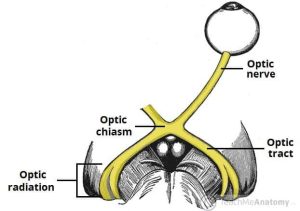
OPTIC NERVES

The optic nerve, also known as cranial nerve II, plays a vital role in the visual pathway. Here’s a detailed description:

Structure:

  1. Origin: The optic nerve originates from the ganglion cells of the retina.
  2. Composition: It’s composed of approximately 1.2 million nerve fibers, which are the axons of retinal ganglion cells.
  3. Intraocular and extraocular portions: The optic nerve has both intraocular (within the eye) and extraocular (outside the eye) portions.

Function:

  1. Transmission of visual information: The optic nerve transmits electrical signals from the retina to the brain, enabling us to perceive and interpret visual stimuli.
  2. Visual pathway: The optic nerve carries visual information from the eye to the optic chiasm, where the signals are combined and transmitted to the lateral geniculate nucleus, and eventually to the visual cortex.

Key features:

  1. Myelination: The optic nerve is myelinated, which enables faster transmission of electrical signals.
  2. Blood supply: The optic nerve receives its blood supply from the ophthalmic artery and its branches.

Clinical significance:

  1. Optic neuritis: Inflammation of the optic nerve can cause vision loss, pain, and impaired color vision.
  2. Glaucoma: Increased intraocular pressure can damage the optic nerve, leading to progressive vision loss.
  3. Optic nerve damage: Trauma, tumors, or other conditions can damage the optic nerve, resulting in vision loss or blindness.

The optic nerve plays a crucial role in enabling us to see and interpret the world around us.
RETINAL BIPOLAR CELLS

Retinal bipolar cells are interneurons in the retina that play a crucial role in visual processing. Key features:

  1. Signal transmission: Bipolar cells transmit signals from photoreceptors (rods and cones) to ganglion cells.
  2. ON and OFF pathways: There are two main types of bipolar cells:
    • ON bipolar cells: Activated by light increments.
    • OFF bipolar cells: Activated by light decrements.
  3. Visual processing: Bipolar cells contribute to the processing of visual information, including contrast enhancement and signal amplification.

Bipolar cells are essential for the transmission and processing of visual signals in the retina, enabling the detection of changes in light intensity and the transmission of these signals to the brain.

CORNEA ENDOTHELIUM

The corneal endothelium is the innermost layer of the cornea. Key features:

  1. Single cell layer: Composed of a single layer of hexagonal cells.
  2. Pump function: Maintains corneal clarity by pumping excess fluid out of the stroma, preventing edema.
  3. Limited regenerative capacity: Unlike the epithelium, the endothelial cells have limited ability to regenerate in humans.
  4. Essential for transparency: The endothelial pump function is crucial for maintaining corneal deturgescence and transparency.

The health of the corneal endothelium is vital for maintaining corneal clarity and proper vision. Damage or dysfunction can lead to corneal edema and vision loss.