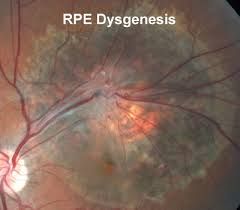
RPE dysgenesis refers to abnormalities in the development of the Retinal Pigment Epithelium (RPE), a layer of cells crucial for photoreceptor health and vision.
RPE dysgenesis can lead to various eye conditions, including:
Retinal dystrophies: Inherited disorders affecting the retina.
Vision impairment: Potential loss of vision due to RPE dysfunction.
If you or someone you know is affected, consulting an eye care professional or a genetic specialist can provide personalized guidance and treatment options.
Not knowing what to expect in routine eye Examination is quite normal. But it is not supposed to be.
It is very important for individuals who are visiting the eye clinic for the first time to know routine eye tests that should be carried out on them, as this will help them know if they are receiving proper Eyecare services or not.
There are six basic routine tests you should expect to receive on your first visit to the eye clinic and they are:
1.Visual acuity: This is a measure of how well, you can see things both at far añd near distance. This test is carried out both at 6metres and at 40cm.
2. External Examination: This is done to access the health of the external structures of your eyes like the cornea, sclera, lids, lashes, pupil, et.c. This is either done with the slit lamp biomicroscope or penlight.
3. Internal Examination: This is also known as funduscopy or ophthalmoscopy. Here the integrity of the internal structures of the eyes are examined. This can be done with the opthalmoscope ( direct and indirect), fundus camera.
4. Tonometry: This is a measure of the intraocular pressure of the eye. This procedure is Carried out with the tonometer. Normal pressure ranges between 10mmhg and 21mmhg.
5. Visual field Examination: This is an Examination that gives an insight on the scope of the visual field. It can either be done manually ( confrontational and bjerrum screen) or automated ( Humphrey visual field analyser).
6. Refraction: This procedure accesses the refractive state of the eye. It is this procedure that determine, wether or not you will need a pair of glasses.