Eagleview Eye Clinic
HOW STRABISMUS AFFECT THE QUALITY OF AN INDIVIDUAL

👓 Strabismus can impact various aspects of an individual’s quality of life, depending on factors like the severity of the condition, age of onset, and how it’s managed.

Potential Effects on Quality of Life

  • Vision and depth perception: Strabismus can affect how well the eyes work together, potentially impacting depth perception, visual clarity, or causing double vision in some cases.
  • Self-esteem and social interactions: Especially in children or teens, noticeable eye misalignment might affect self-confidence or interactions with peers.
  • Daily activities: Depending on the severity, strabismus might impact activities like reading, driving, or tasks requiring precise eye coordination.
  • Treatment and management: Some individuals might need glasses, patches, exercises, or surgery, which can influence daily routines or emotional well-being.

Varied Experiences

  • Adaptation and coping: Many people adapt to strabismus or learn to manage its effects on their daily lives.
  • Treatment outcomes: With proper management or treatment, many individuals with strabismus lead lives with minimal impact on their overall quality of life
NYSTAGMUS

Nystagmus: Key Features

Nystagmus is a condition characterized by involuntary eye movements. Key aspects include:

Characteristics

  • Involuntary movements: Rhythmic oscillations of the eyes, can be horizontal, vertical, or rotational.
  • Types: Congenital (present at birth) or acquired (develops later due to other conditions).

Causes and Associations

  • Congenital nystagmus: Often associated with conditions like albinism, low vision, or neurological issues.
  • Acquired nystagmus: Can result from neurological conditions, medications, or inner ear problems.

Symptoms and Impact

  • Vision issues: Reduced visual acuity or clarity due to eye movements.
  • Dizziness or imbalance: Some may experience these due to associated vestibular issues.

Management

  • Treatment of underlying cause: If possible.
  • Glasses or contact lenses: May help with vision correction.
  • Surgery or therapy: Sometimes considered for specific cases.

ANTERIOR CHAMBER ANGLE

The anterior chamber angle is a critical area in the eye. Key features:

  1. Location: The angle formed by the junction of the iris and cornea in the anterior chamber.
  2. Importance:
    • Contains the trabecular meshwork, which drains aqueous humor
    • Plays a key role in regulating intraocular pressure
  3. Clinical significance: Narrowing or closure of the anterior chamber angle can lead to angle-closure glaucoma.

The anatomy of the anterior chamber angle is important for understanding glaucoma and other ocular conditions.

AQUEOUS HUMOR

The aqueous humor is a clear fluid in the eye. Key features:

  1. Location: Fills the anterior chamber (between the cornea and iris) and posterior chamber (between the iris and lens).
  2. Function:
    • Maintains intraocular pressure
    • Provides nutrients to the lens and cornea
    • Removes waste products
  3. Production and drainage: Produced by the ciliary body, drained through the trabecular meshwork.

Imbalances in aqueous humor dynamics can lead to conditions like glaucoma.

THE GLÀND OF THE ZEIS

The Glands of Zeis are:

  1. Sebaceous glands: Associated with the eyelashes, producing sebum.
  2. Function: Help keep the eyelashes and surrounding skin healthy, moisturized.
  3. Location: Located near the base of the eyelashes.

Dysfunction or blockage of the Glands of Zeis can lead to conditions like:

  1. Styes (hordeolum)
  2. Chalazion
  3. Blepharitis (inflammation of the eyelids)

These glands play a role in maintaining eyelid and ocular surface health.

THE GLÀND OF THE ZEIS

The Glands of Zeis are:

  1. Sebaceous glands: Associated with the eyelashes, producing sebum.
  2. Function: Help keep the eyelashes and surrounding skin healthy, moisturized.
  3. Location: Located near the base of the eyelashes.

Dysfunction or blockage of the Glands of Zeis can lead to conditions like:

  1. Styes (hordeolum)
  2. Chalazion
  3. Blepharitis (inflammation of the eyelids)

These glands play a role in maintaining eyelid and ocular surface health.

MEIBOMIAN GLAND

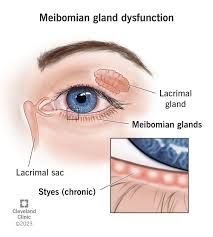
The Meibomian glands are small oil-producing glands in the eyelids. Key features:

  1. Location: Located in the tarsal plates of the eyelids.
  2. Function: Produce meibum, a lipid secretion that helps to:
    • Lubricate the eyes
    • Prevent evaporation of tears
    • Maintain the health of the ocular surface
  3. Importance: Dysfunction of the Meibomian glands can lead to:
    • Dry eye syndrome
    • Blepharitis (inflammation of the eyelids)
    • Ocular surface disorders

The Meibomian glands play a crucial role in maintaining the health and function of the ocular surface.

RETINAL GANGLION CELLS

Retinal ganglion cells (RGCs) are a type of neuron in the retina. Key features:

  1. Signal transmission: RGCs receive visual information from bipolar cells and transmit it to the brain via the optic nerve.
  2. Visual processing: RGCs play a crucial role in processing visual information, including:
    • Detecting light intensity and patterns
    • Processing color and contrast
    • Detecting motion and direction
  3. Types: There are several types of RGCs, each responding to different visual stimuli.

RGCs are essential for transmitting visual information from the eye to the brain, enabling us to perceive and interpret visual stimuli.

CORNEA ENDOTHELIUM

The corneal endothelium is the innermost layer of the cornea. Key features:

  1. Single cell layer: Composed of a single layer of hexagonal cells.
  2. Pump function: Maintains corneal clarity by pumping excess fluid out of the stroma, preventing edema.
  3. Limited regenerative capacity: Unlike the epithelium, the endothelial cells have limited ability to regenerate in humans.
  4. Essential for transparency: The endothelial pump function is crucial for maintaining corneal deturgescence and transparency.

The health of the corneal endothelium is vital for maintaining corneal clarity and proper vision. Damage or dysfunction can lead to corneal edema and vision loss.

CORNEA EPITHELIUM

The corneal epithelium is the outermost layer of the cornea. Key features:

  1. Barrier function: Protects the eye from external factors like dust, bacteria, and other foreign particles.
  2. Non-keratinized stratified squamous epithelium: Composed of multiple layers of flat cells that are tightly packed.
  3. Rapid regeneration: The corneal epithelium has a high capacity for regeneration, helping to maintain the integrity of the cornea.
  4. Smooth surface: Contributes to the clarity and smoothness of the cornea, essential for clear vision.

The corneal epithelium plays a crucial role in maintaining corneal health and clarity, and its integrity is vital for protecting the eye and supporting vision.