Eagleview Eye Clinic

Tag low vision

LOW VISION MAGNIFIERS

Low vision magnifiers are devices designed to help individuals with visual impairments maximize their remaining vision. These tools can significantly enhance daily life by providing clear and manageable information.

Types of Low Vision Magnifiers

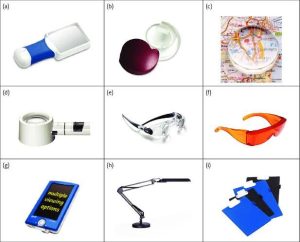
  • Handheld Magnifying Glasses: Portable and lightweight, these magnifiers are ideal for reading small print, labels, and menus. They come in various magnification strengths (2x to 10x) and are suitable for individuals with macular degeneration, cataracts, or general low vision.
  • Desktop Electronic Magnifiers: These stationary devices project enlarged images onto a screen, allowing users to read documents, view photos, and see objects with enhanced clarity. They’re perfect for extended reading sessions and can help individuals with macular degeneration, diabetic retinopathy, and glaucoma.
  • Wearable Magnifying Glasses: Hands-free magnification makes these glasses ideal for tasks requiring precision, such as hobbies or cooking. They’re customizable and provide consistent magnification, enabling users to engage in everyday activities with confidence.
  • Digital Portable Magnifiers: Compact and lightweight, these devices are perfect for on-the-go reading and writing. They often feature adjustable zoom and color contrast options, making them suitable for individuals with various visual impairments.
  • Electronic Magnifiers: These high-tech devices incorporate digital enhancements like contrast adjustment, brightness control, and text-to-speech features. They’re designed to assist individuals with severe visual impairments and can be used for reading, writing, and other daily tasks.

Benefits of Low Vision Magnifiers

Low vision magnifiers can ¹ ² ³:

  • Enhance visual clarity and readability
  • Increase independence and confidence
  • Facilitate daily tasks, such as reading, writing, and cooking
  • Improve overall quality of life

Popular Brands and Products

Some notable brands and products include ⁴ ⁵ ⁶:

  • Vision Buddy: A wearable magnifying device with a high-resolution display and hands-free design
  • Amigo Portable Low Vision Electronic Magnifier: A simple-to-use device with a 6.5-inch viewing screen and adjustable magnification
  • Pebble HD: A compact and lightweight portable magnifier with a 4.3-inch screen
  • Zoomax Luna: A portable video magnifier with a range of magnification options and high-definition display
  • HumanWare Prodigi: An all-in-one PC with electronic video magnification capabilities

Where to Find Low Vision Magnifiers

You can find low vision magnifiers at specialized stores, online marketplaces, or through low vision services and resource centers. It’s essential to consult with a low vision specialist to determine the best type of magnifier for your specific needs
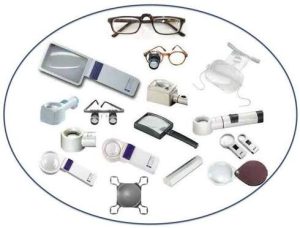
LOW VISION DEVICES

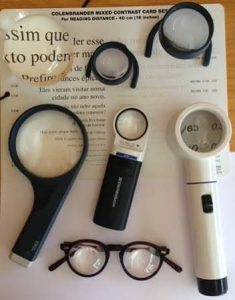
👓 Low vision devices are tools designed to help individuals with low vision maximize their remaining vision and improve daily functioning. These devices can be optical, electronic, or non-optical.

Types of Low Vision Devices

  • Magnifiers: Handheld or stand magnifiers that enlarge text or objects.
  • Telescopes: Devices for distance vision, useful for activities like watching TV or seeing board work in a classroom.
  • Electronic devices: Smartphones, tablets, or computers with accessibility features like text-to-speech, zoom, or high-contrast modes.
  • Large print materials: Books, labels, or other materials with larger font sizes.
  • Specialized lighting: Bright or task-specific lighting to improve visibility.

Assistive Technologies

  • Screen readers: Software that reads aloud text on screens.
  • Magnification apps: Apps that enlarge text or objects on smartphones or tablets.
  • Smart glasses: Wearable devices with magnification or object recognition capabilities.
IMPACT OF LOW VISION IN THE LIFE OF AN INDIVIDUAL WITH LOW VISION

👓 Low vision can significantly impact various aspects of an individual’s life, affecting daily activities, independence, and overall well-being.

Potential Impacts of Low Vision

  • Daily tasks: Challenges with reading, cooking, managing finances, or recognizing faces can become more difficult.
  • Mobility and navigation: Difficulty seeing obstacles, reading signs, or navigating unfamiliar places can impact independence and confidence.
  • Social interactions: Low vision might affect participation in social activities, leading to feelings of isolation or frustration.
  • Emotional well-being: Adjusting to vision loss can be emotionally challenging, potentially leading to feelings of sadness, anxiety, or depression.

Adaptation and Support

  • Assistive devices: Tools like magnifiers, large print materials, or technology with accessibility features can help individuals adapt.
  • Rehabilitation services: Low vision rehabilitation can provide strategies and training to maximize remaining vision and independence.
  • Support networks: Connecting with others who have similar experiences can offer emotional support and practical advice.
PATHOLOGICAL CONDITION THAT CAN  CAUSE LOW VISION

The following are some of the major  pathological conditions that can result in low vision:

Cataract

Glaucoma

Retinitis pigmentosa

Age related macular degeneration

WHEN SURGERY FAILS…

In time past and even in recent times, we have had people who came down with eye conditions like glaucoma, cataract, retinitis pigmentosa, macular degeneration and even after treatment, their vision never improved again.

Even after series of surgeries, patients could no longer get their lives back.

It is usually very difficult to cope with the new reality of not been able to do those things that puts smiles on your face and bring joy to your soul.

Low vision simply refers to visual acuity of less than 6/18 in the better and visual field of less 5 degrees of arc with the presence of underlying pathologies.

It is a very sad reality for most of these patients to come to terms with the fact that they have been diagnosed with low vision and they might have to make some permanent and noticeable changes to their lives inorder to go through life without much hinderance.

Low vision therapy employs the use of both optical and non optical low vision aids to maximize the little vision the patient has left.

Low vision aids includes telescopes, magnifiers, CCTV et.c

WHEN SURGERY FAILS…

In time past and even in recent times, we have had people who came down with eye conditions like glaucoma, cataract, retinitis pigmentosa, macular degeneration and even after treatment, their vision never improved again.

Even after series of surgeries, patients could no longer get their lives back.

It is usually very difficult to cope with the new reality of not been able to do those things that puts smiles on your face and bring joy to your soul.

Low vision simply refers to visual acuity of less than 6/18 in the better and visual field of less 5 degrees of arc with the presence of underlying pathologies.

It is a very sad reality for most of these patients to come to terms with the fact that they have been diagnosed with low vision and they might have to make some permanent and noticeable changes to their lives inorder to go through life without much hinderance.

Low vision therapy employs the use of both optical and non optical low vision aids to maximize the little vision the patient has left.

Low vision aids includes telescopes, magnifiers, CCTV et.c

WHEN SURGERY FAILS…

In time past and even in recent times, we have had people who came down with eye conditions like glaucoma, cataract, retinitis pigmentosa, macular degeneration and even after treatment, their vision never improved again.

Even after series of surgeries, patients could no longer get their lives back.

It is usually very difficult to cope with the new reality of not been able to do those things that puts smiles on your face and bring joy to your soul.

Low vision simply refers to visual acuity of less than 6/18 in the better and visual field of less 5 degrees of arc with the presence of underlying pathologies.

It is a very sad reality for most of these patients to come to terms with the fact that they have been diagnosed with low vision and they might have to make some permanent and noticeable changes to their lives inorder to go through life without much hinderance.

Low vision therapy employs the use of both optical and non optical low vision aids to maximize the little vision the patient has left.

Low vision aids includes telescopes, magnifiers, CCTV et.c