Eagleview Eye Clinic

Tag retina

AMACRINE CELLS

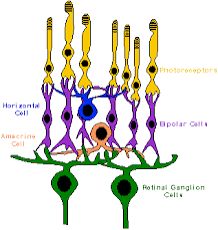
Amacrine cells are a type of interneuron in the retina. They play a crucial role in visual processing by:

  1. Modulating signal transmission: Amacrine cells interact with bipolar cells and ganglion cells, influencing the transmission of visual signals.
  2. Regulating retinal circuitry: They help refine and process visual information within the retina.
  3. Inhibitory functions: Many amacrine cells release inhibitory neurotransmitters, such as GABA or glycine, to modulate the activity of other retinal neurons.

Amacrine cells contribute to various aspects of visual processing, including:

  • Edge detection
  • Motion detection
  • Contrast sensitivity
  • Adaptation to changing light conditions

There are many subtypes of amacrine cells, each with distinct morphological and functional properties, allowing for complex and nuanced visual processing in the retina.
PHOTORECEPTORS

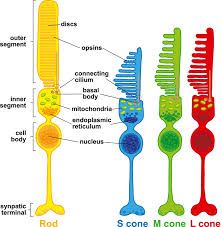
Photoreceptors are specialized cells in the retina that convert light into electrical signals. There are two main types:

1. Rods

  • Function: Responsible for vision in low light conditions (scotopic vision) and peripheral vision.
  • Distribution: Highly concentrated in the peripheral retina.
  • Sensitivity: More sensitive to light than cones but do not detect color.

2. Cones

  • Function: Responsible for color vision and high-acuity vision in bright light conditions (photopic vision).
  • Distribution: Concentrated in the central retina, particularly in the fovea.
  • Types: There are three types of cones, each sensitive to different wavelengths of light:
    • S-cones (short-wavelength): Sensitive to blue light.
    • M-cones (medium-wavelength): Sensitive to green light.
    • L-cones (long-wavelength): Sensitive to red light.

Together, rods and cones enable us to perceive a wide range of light intensities and colors, contributing to our overall visual experience.

RETINA

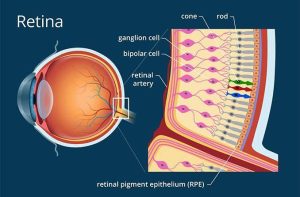
The retina is a complex neural tissue lining the inner surface of the eye. It’s responsible for converting light into electrical signals, which are then transmitted to the brain, enabling us to perceive visual information.

Key components:

  1. Photoreceptors (rods and cones): Convert light into electrical signals.
  2. Bipolar cells: Transmit signals from photoreceptors to ganglion cells.
  3. Ganglion cells: Send signals to the brain via the optic nerve.
  4. Retinal pigment epithelium (RPE): Supports photoreceptors and maintains retinal health.

The retina plays a vital role in vision, and its health is crucial for maintaining visual acuity and function.