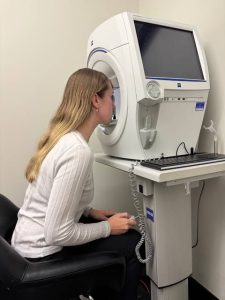
The Bjerrum tangent screen is a device used in ophthalmology to assess the visual field, particularly the central and paracentral areas. It’s a flat surface with a tangent curve marked on it, used to map out the field of vision.
How it’s used:
- Patient fixation: The patient fixates on a central point.
- Stimulus presentation: A stimulus (e.g., a small object or light) is moved along the tangent screen.
- Visual field mapping: The patient indicates when they see the stimulus, allowing the examiner to map out the visual field.
Purpose:
The Bjerrum tangent screen is used to:
- Detect visual field defects: Identify defects in the central and paracentral visual field.
- Monitor glaucoma: Track changes in the visual field associated with glaucoma.
- Assess optic nerve function: Evaluate the function of the optic nerve.
The Bjerrum tangent screen is a useful tool for assessing and monitoring visual field defects, particularly in glaucoma patients.