Eagleview Eye Clinic

Category Eye Health Education

CHORIORETINITIS SCLOPETARIA

One of the eye problems that can occur as a result of trauma from high velocity objects is chorioretinitis sclopetaria.

Chorioretinitis sclopetaria is a condition whereby the choroid ( third layer of the uvea, which supplies blood and nutrient to retina and other area) and the retina (the vision house of the eye) gets ruptured due to trauma from high velocity objects.

This damage is as a result of transmitted sound waves from impact without the object penetrating the eyes.

Signs and symptoms includes visual reduction, pain, et.c

Treatment may require surgical intervention.

IRIDOCYCLITIS

Iridocyclitis is an inflammation of the iris and ciliary body.

Causes are usually idiopathic in nature. But most times  it could be as a result of autoimmune conditions, infection or even trauma.

Signs and symptoms includes pains, red eyes, blurry vision, light sensitivity etc..

Delay in treatment can result in angle closure glaucoma, irregular pupil and vision loss.

Treatment is usually a combination of anticholinergic drugs and steroids.

SYNECHIA

Synechia is a condition whereby the iris adheres to either the cornea ( anterior synechia) or the lens ( posterior synechia)..

This synechia is capable of causing glaucoma. Hence the need to treat as soon as possible.

Synechia is caused by both anterior and posterior uveitis, iridocyclitis, iritis or even trauma.

Prognosis is good if treated as soon as possible.

Synechia is treated with a combination of mydriatics, steroids and prostaglandin analogues.

COLOBOMA

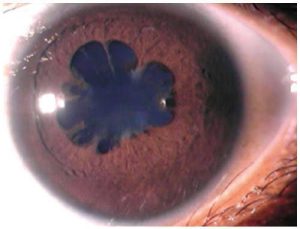
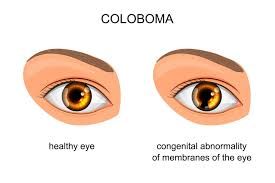
Coloboma is an embryologic condition where a tissue does not form completely..

It could affect the iris, the lens, and the optic disc.

Coloboma consequences ranges from no effect in vision to complete blindness depending on the area of the eye that is affected

LISCH NODULES

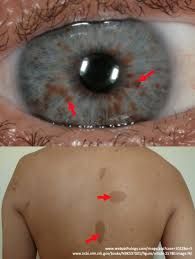
Lisch nodules are small benign , pigmented bumps that appear on the iris (colored part of the eyes).

They are the Hallmark of neurofibromatosis 1.

This lisch nodules is usually seen at birth eventually increase as one gets older . They appear as light Brown or yellowish brown

Lisch nodules are benign and do not affect vision.

SECONDARY ANGLE CLOSURE GLAUCOMA

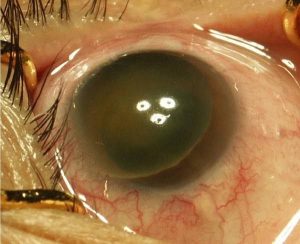
This is angle closure Glaucoma that’s is attributed to a known cause, e.g trauma, inflammation etc.

This particular condition most times comes with iris inflammation. Signs and symptoms includes pain, red eyes, fixed and dilated pupils, cornea odema ( occasionally).

Treatment includes hyperosmotics, miotics and anti Glaucoma drugs, while ensuring that the primary cause is properly treated.

Prognosis is very good, but delayed treatment can result in fatal consequences.

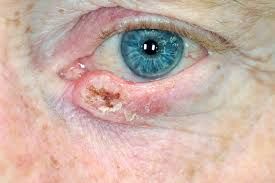
LID SQUAMOUS CELL CARCINOMA

This is a rare type of skin cancer that affects the lids.

It is very aggressive and has a high mortality and morbidity rate.

It is painless and  appears as a nodule or plaque with hyperkeratotic or ulcerated surface.

Since it multiplies really fast, it’ is early detection is key to Good prognosis during treatment.

Risk factors includes, regular exposure to uv rays, fair skin, preexisting skin condition.

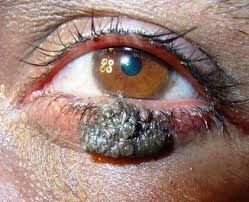
SEBORRHEIC KERATOSIS

This is a non cancerous growth appearing as a wax brown tan, usually on the lower eye lid.

This growth is quite common and usually starts at an early age while progressing as one grows older.

Seborrheic keratosis is quite harmless but it can be removed if you find it discomforting.

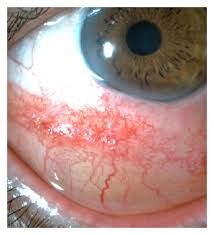
CONJUNCTIVAL LYMPHANGIOMA

Conjunctival lymphangioma occurs when the lymphatic vessels of the conjunctival dilate and enlarge forming a cyst.

It can appear as a single or multiple cystic lesions. Causes are unknown but then , it has been attributed to poor development of the lymphatic system..

Signs and symptoms includes, reddish lumps, foreign body sensation et.c

Treatment often  involves surgical removal or aspiration if it becomes problematic.

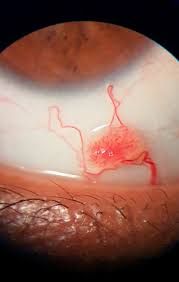
CONJUNCTIVAL PAPILLOMA

This is a harmless growth on the outer surface of the eye. It is usually associated with people with human papilloma virus.

Normally this growth harmless but it can be discomforting, causing itching, pain, blurry vision.

Normally if is not causing any problem, it can be ignored. But can be removed surgically depending on the size and location.