Eagleview Eye Clinic

Tag eye Examination

CORNEA STROMA

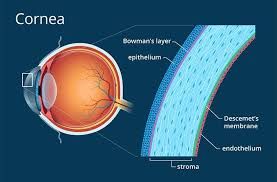
The corneal stroma is the thick, middle layer of the cornea, accounting for about 90% of its thickness. It’s composed of:

  1. Collagen fibers: Highly organized and regularly arranged collagen lamellae, which provide strength, transparency, and refractive structure.
  2. Kerocytes: Flattened fibroblasts scattered between the collagen fibers, involved in maintaining the extracellular matrix.

The corneal stroma’s unique structure and organization are crucial for:

  • Corneal transparency
  • Refractive properties
  • Mechanical strength

The precise arrangement of collagen fibers in the stroma is essential for maintaining corneal clarity and function.
RETINAL LAYERS

The retina consists of several layers:

  1. Retinal Pigment Epithelium (RPE): The outermost layer, supporting photoreceptors.
  2. Photoreceptor Layer (Rods and Cones): Converts light into electrical signals.
  3. Outer Nuclear Layer: Contains nuclei of photoreceptor cells.
  4. Outer Plexiform Layer: Synapses between photoreceptors and bipolar cells.
  5. Inner Nuclear Layer: Contains nuclei of bipolar, Müller, and amacrine cells.
  6. Inner Plexiform Layer: Synapses between bipolar and ganglion cells.
  7. Ganglion Cell Layer: Contains ganglion cells that transmit signals to the brain.
  8. Nerve Fiber Layer: Contains axons of ganglion cells forming the optic nerve.
  9. Internal Limiting Membrane: The boundary between the retina and the vitreous humor.

These layers work together to convert light into electrical signals, process visual information, and transmit it to the brain.

RETINA

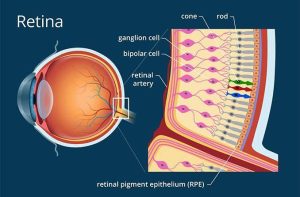
The retina is a complex neural tissue lining the inner surface of the eye. It’s responsible for converting light into electrical signals, which are then transmitted to the brain, enabling us to perceive visual information.

Key components:

  1. Photoreceptors (rods and cones): Convert light into electrical signals.
  2. Bipolar cells: Transmit signals from photoreceptors to ganglion cells.
  3. Ganglion cells: Send signals to the brain via the optic nerve.
  4. Retinal pigment epithelium (RPE): Supports photoreceptors and maintains retinal health.

The retina plays a vital role in vision, and its health is crucial for maintaining visual acuity and function.

LAYERS OF THE CHOROID

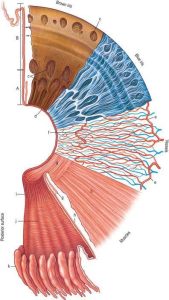
The choroid is a vascular layer in the eye between the sclera and retina. It consists of several layers:

1. Suprachoroid Lamina (or Suprachoroid Layer)

  • The outermost layer of the choroid, adjacent to the sclera.
  • Composed of loose connective tissue and melanocytes.

2. Choriocapillaris

  • A layer of capillaries that supplies oxygen and nutrients to the outer retina.
  • Fenestrated capillaries allow for the exchange of substances.

3. Bruch’s Membrane

  • A thin, acellular layer separating the choroid from the retinal pigment epithelium (RPE).
  • Composed of collagen and elastin fibers.

These layers work together to provide nourishment to the retina and support its function. The choroid plays a crucial role in maintaining the health and function of the retina.

LAYERS OF THE IRIS

The iris consists of several layers:

  1. Anterior border layer: The front layer of the iris, consisting of fibroblasts and melanocytes.
  2. Stroma: The middle layer, composed of connective tissue, blood vessels, and melanocytes that give the iris its color.
  3. Anterior epithelium (Anterior pigmented epithelium): A layer of pigmented cells.
  4. Posterior epithelium (Posterior pigmented epithelium): A layer of densely pigmented cells that block light from entering the eye except through the pupil.

These layers work together to control the amount of light entering the eye by adjusting the size of the pupil and give the iris its color and structure.

LAYERS OF THE CORNEA

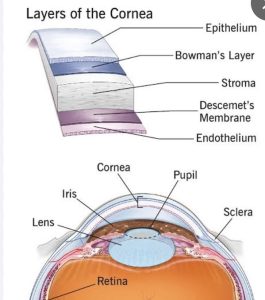
The cornea, the transparent outer layer of the eye, consists of five distinct layers:

  1. Epithelium: The outermost layer, composed of stratified squamous epithelial cells, providing a barrier against external factors.
  2. Bowman’s layer: A dense, acellular layer of collagen fibers beneath the epithelium, providing strength and structure.
  3. Stroma: The thickest layer, composed of collagen fibers and keratocytes, making up about 90% of the cornea’s thickness.
  4. Descemet’s membrane: A thin, porous layer of collagen fibers produced by endothelial cells.
  5. Endothelium: The innermost layer, composed of a single layer of endothelial cells, responsible for maintaining corneal clarity by regulating fluid and electrolyte balance.

These layers work together to maintain the cornea’s transparency, structure, and function.

VITREOUS BODY

The vitreous body, or vitreous humor, is a clear, gel-like substance that fills the space between the lens and the retina in the eye. It:

  1. Maintains eye shape: Gives the eye its spherical shape.
  2. Supports retina: Helps keep the retina in place.
  3. Transmits light: Allows light to pass through to the retina.

The vitreous body is composed of:

  1. Water: About 99% water.
  2. Collagen fibers: Provides structure and support.
  3. Hyaluronic acid: Helps maintain its gel-like consistency.

As we age, the vitreous body can undergo changes, such as:

  1. Vitreous detachment: Separation from the retina.
  2. Floaters: Small particles that cast shadows on the retina.

Issues with the vitreous body can lead to conditions like retinal detachment or vision problems.

ZONULE FIBRES

Zonular fibers, also known as suspensory ligaments or zonules of Zinn, are tiny, thread-like structures in the eye. They:

  1. Connect the lens to the ciliary body: Zonular fibers attach the crystalline lens to the ciliary body.
  2. Suspend the lens: They hold the lens in place, allowing it to change shape for focusing.
  3. Transmit forces: Zonular fibers transmit forces from the ciliary muscles to the lens, enabling accommodation.

Zonular fibers play a crucial role in:

  1. Lens accommodation: They help change the lens shape for near or far vision.
  2. Maintaining lens position: They keep the lens centered and stable.

Dysfunction or damage to zonular fibers can lead to vision problems, such as:

  1. Lens subluxation or dislocation
  2. Vision disturbances

Zonular fibers are an essential part of the eye’s anatomy, supporting the lens and enabling clear vision.

CILIARY BODY

The ciliary body is a ring-shaped structure in the eye, located behind the iris. It’s a crucial part of the eye’s anatomy, responsible for:

  1. Aqueous humor production: The ciliary body produces the clear fluid (aqueous humor) that fills the anterior and posterior chambers of the eye.
  2. Lens accommodation: The ciliary muscles control the shape of the lens, allowing it to focus on near or far objects.
  3. Lens suspension: The ciliary body is connected to the lens via zonular fibers, which suspend the lens in place.

The ciliary body consists of two main parts:

  1. Ciliary muscles: These muscles contract and relax to change the lens shape for focusing.
  2. Ciliary processes: These are finger-like extensions that produce aqueous humor.

The ciliary body plays a vital role in maintaining the eye’s health and function, and any issues with it can lead to vision problems or eye diseases.

CONJUNCTIVA

The conjunctiva is a thin, transparent, mucous membrane that covers the anterior (front) part of the eye and the inside of the eyelids. It plays a crucial role in maintaining eye health and function.

Key characteristics:

  1. Location: The conjunctiva covers:
    • The sclera (white part of the eye)
    • The inside of the upper and lower eyelids (palpebral conjunctiva)
    • The fornices (areas where the eyelids meet the eye)
  2. Function: The conjunctiva:
    • Produces mucus to lubricate the eye and facilitate smooth movement
    • Helps protect the eye from infection and foreign particles
    • Aids in maintaining the health of the cornea
  3. Structure: The conjunctiva consists of:
    • Epithelial cells
    • Substantia propria (a layer of connective tissue)
  4. Importance: The conjunctiva is essential for:
    • Maintaining eye comfort and moisture
    • Preventing infection and inflammation
    • Supporting the overall health of the eye

Common conditions: Conjunctivitis (pink eye), allergies, and dry eye syndrome can affect the conjunctiva, causing symptoms such as redness, itching, discharge, and discomfort.