Eagleview Eye Clinic

Tag eye Examination

TYPES OF STRABISMUS

👓 Strabismus, also known as crossed eyes or squint, is a condition where the eyes don’t align properly. There are several types of strabismus based on the direction of the misalignment and other characteristics.

Types of Strabismus

  • Esotropia: One or both eyes turn inward toward the nose.
  • Exotropia: One or both eyes turn outward away from the nose.
  • Hypertropia: One eye turns upward relative to the other eye.
  • Hypotropia: One eye turns downward relative to the other eye.

Other Classifications

  • Concomitant strabismus: The amount of misalignment is the same in all directions of gaze.
  • Incomitant strabismus: The amount of misalignment varies with the direction of gaze.
  • Intermittent strabismus: The malignment occurs sometimes but not all the time.
OCULAR ALBINISM

Ocular Albinism: Detailed Information

Ocular albinism is a group of inherited conditions affecting the pigmentation of the eyes. Key aspects include:

Characteristics

  • Reduced pigmentation: Mainly affects the iris and retina.
  • Vision problems: Common issues include reduced visual acuity, nystagmus (involuntary eye movements), strabismus, and photophobia (sensitivity to light).
  • Type 1 (OA1): Most common form, typically X-linked inheritance affecting males more severely.

Symptoms and Effects

  • Visual impairment: Range from mild to significant vision loss.
  • Nystagmus and strabismus: Common associated eye movement issues.
  • Photophobia: Sensitivity to light due to lack of pigmentation.

Genetics and Diagnosis

  • Inheritance: Usually X-linked for OA1, affecting males primarily.
  • Diagnosis: Often based on clinical findings like iris transillumination defects and visual issues.

Management

  • Visual aids: Glasses or contact lenses may help.
  • Low vision support: Services can assist with daily challenges.
  • Protection from sunlight: Due to photophobia.

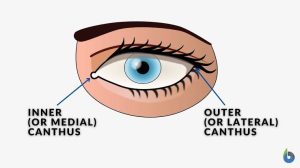
LATERAL CANTHUS

The lateral canthus is a part of the eye’s anatomy. Key features:

  1. Location: The outer corner of the eye where the upper and lower eyelids meet.
  2. Function:
    • Helps with eyelid stability and movement.
    • Contributes to the overall shape and function of the eyelids.
  3. Clinical significance:
    • Can be involved in conditions like lateral canthal tendon laxity or injuries.
    • Sometimes a focus in oculoplastic surgery for cosmetic or functional reasons.

The lateral canthus is one of the anatomical landmarks of the eye.

OPTIC CHIASM

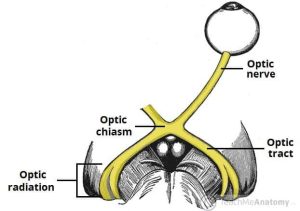
The optic chiasm is a part of the visual pathway. Key features:

  1. Location: Located at the base of the brain, above the pituitary gland.
  2. Function:
    • Nerve fibers from the nasal part of each retina cross over (decussate) here.
    • Allows for integration of visual information from both eyes.
  3. Importance:
    • Plays a crucial role in binocular vision and visual field processing.
    • Lesions or damage to the optic chiasm can cause specific visual field defects (like bitemporal hemianopia).

The optic chiasm is a key structure in the visual pathway.

ANTERIOR CHAMBER ANGLE

The anterior chamber angle is a critical area in the eye. Key features:

  1. Location: The angle formed by the junction of the iris and cornea in the anterior chamber.
  2. Importance:
    • Contains the trabecular meshwork, which drains aqueous humor
    • Plays a key role in regulating intraocular pressure
  3. Clinical significance: Narrowing or closure of the anterior chamber angle can lead to angle-closure glaucoma.

The anatomy of the anterior chamber angle is important for understanding glaucoma and other ocular conditions.

TRABECULAE MESHWORK

The trabecular meshwork is a key structure in the eye. Key features:

  1. Location: Located near the base of the iris, in the angle of the anterior chamber.
  2. Function:
    • Drains aqueous humor from the eye
    • Regulates intraocular pressure by controlling outflow of aqueous humor
  3. Importance: Dysfunction or blockage of the trabecular meshwork can lead to increased intraocular pressure and conditions like glaucoma.

The trabecular meshwork plays a crucial role in maintaining healthy intraocular pressure.

OPTIC NERVES

The optic nerve, also known as cranial nerve II, plays a vital role in the visual pathway. Here’s a detailed description:

Structure:

  1. Origin: The optic nerve originates from the ganglion cells of the retina.
  2. Composition: It’s composed of approximately 1.2 million nerve fibers, which are the axons of retinal ganglion cells.
  3. Intraocular and extraocular portions: The optic nerve has both intraocular (within the eye) and extraocular (outside the eye) portions.

Function:

  1. Transmission of visual information: The optic nerve transmits electrical signals from the retina to the brain, enabling us to perceive and interpret visual stimuli.
  2. Visual pathway: The optic nerve carries visual information from the eye to the optic chiasm, where the signals are combined and transmitted to the lateral geniculate nucleus, and eventually to the visual cortex.

Key features:

  1. Myelination: The optic nerve is myelinated, which enables faster transmission of electrical signals.
  2. Blood supply: The optic nerve receives its blood supply from the ophthalmic artery and its branches.

Clinical significance:

  1. Optic neuritis: Inflammation of the optic nerve can cause vision loss, pain, and impaired color vision.
  2. Glaucoma: Increased intraocular pressure can damage the optic nerve, leading to progressive vision loss.
  3. Optic nerve damage: Trauma, tumors, or other conditions can damage the optic nerve, resulting in vision loss or blindness.

The optic nerve plays a crucial role in enabling us to see and interpret the world around us.

CORNEA STROMA

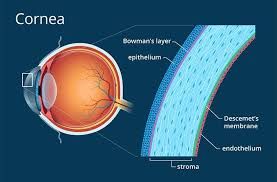
The corneal stroma is the thick, middle layer of the cornea, accounting for about 90% of its thickness. It’s composed of:

  1. Collagen fibers: Highly organized and regularly arranged collagen lamellae, which provide strength, transparency, and refractive structure.
  2. Kerocytes: Flattened fibroblasts scattered between the collagen fibers, involved in maintaining the extracellular matrix.

The corneal stroma’s unique structure and organization are crucial for:

  • Corneal transparency
  • Refractive properties
  • Mechanical strength

The precise arrangement of collagen fibers in the stroma is essential for maintaining corneal clarity and function.

RETINAL LAYERS

The retina consists of several layers:

  1. Retinal Pigment Epithelium (RPE): The outermost layer, supporting photoreceptors.
  2. Photoreceptor Layer (Rods and Cones): Converts light into electrical signals.
  3. Outer Nuclear Layer: Contains nuclei of photoreceptor cells.
  4. Outer Plexiform Layer: Synapses between photoreceptors and bipolar cells.
  5. Inner Nuclear Layer: Contains nuclei of bipolar, Müller, and amacrine cells.
  6. Inner Plexiform Layer: Synapses between bipolar and ganglion cells.
  7. Ganglion Cell Layer: Contains ganglion cells that transmit signals to the brain.
  8. Nerve Fiber Layer: Contains axons of ganglion cells forming the optic nerve.
  9. Internal Limiting Membrane: The boundary between the retina and the vitreous humor.

These layers work together to convert light into electrical signals, process visual information, and transmit it to the brain.

RETINA

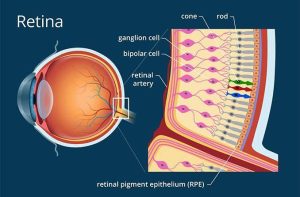
The retina is a complex neural tissue lining the inner surface of the eye. It’s responsible for converting light into electrical signals, which are then transmitted to the brain, enabling us to perceive visual information.

Key components:

  1. Photoreceptors (rods and cones): Convert light into electrical signals.
  2. Bipolar cells: Transmit signals from photoreceptors to ganglion cells.
  3. Ganglion cells: Send signals to the brain via the optic nerve.
  4. Retinal pigment epithelium (RPE): Supports photoreceptors and maintains retinal health.

The retina plays a vital role in vision, and its health is crucial for maintaining visual acuity and function.