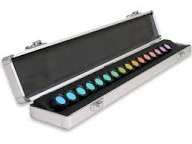
The Farnsworth D15 test is a color vision test used to assess color perception and detect color vision deficiencies. Here’s a detailed overview:
Test Procedure:
Colored caps: The test consists of 15 colored caps, each with a specific hue.
Arranging the caps: The patient is asked to arrange the caps in a specific order, typically in a hue sequence.
Testing conditions: The test is usually administered in a well-lit room with good color rendering.
Purpose:
The Farnsworth D15 test is used to:
Detect color vision deficiencies: Identify individuals with color vision problems, particularly in the blue-yellow axis.
Assess color discrimination: Evaluate the patient’s ability to distinguish between different colors.
Monitor color vision: Track changes in color vision over time or after treatment.
Scoring and Interpretation:
Error score: The number and type of errors are recorded and scored.
Color confusion index: The results are often presented as a color confusion index, which indicates the severity of color vision deficiency.
Interpretation: The results help diagnose and classify color vision deficiencies, such as tritanopia (blue-yellow deficiency).
Applications:
Occupational vision assessments: Used in industries where color vision is critical, such as aviation, transportation, or graphic design.
Clinical assessments: Helps diagnose and manage color vision problems in patients.
Research: Used in studies on color vision and its applications.
The Farnsworth D15 test is a valuable tool for assessing color vision and detecting color vision deficiencies, enabling targeted interventions and accommodations.
The Titmus fly test, also known as the Titmus stereo test or Titmus test, is a widely used assessment tool for evaluating stereopsis, which is the ability to perceive depth and 3D vision.
How it works:
Polarized glasses: The patient wears polarized glasses.
Image presentation: The patient views a series of images, including a fly or other objects, through the polarized glasses.
Depth perception: The images are designed to create a sense of depth, and the patient is asked to identify the objects or shapes that appear to be raised or recessed.
Purpose:
The Titmus test is used to:
Assess stereopsis: Evaluate the patient’s ability to perceive depth and 3D vision.
Detect binocular vision problems: Identify issues with binocular vision, such as strabismus or amblyopia.
Monitor treatment progress: Track changes in stereopsis during treatment or therapy.
Common applications:
Pediatric vision screening: Often used in children’s vision screenings to assess depth perception.
Vision therapy: Used to evaluate and improve binocular vision and stereopsis.
Occupational vision assessments: May be used in certain occupations that require depth perception.
The Titmus fly test is a valuable tool for assessing stereopsis and binocular vision, helping practitioners diagnose and manage vision problems.
The Maddox wing test is a subjective test used in ophthalmology and orthoptics to measure heterophoria (latent strabismus) and assess binocular vision. It involves a device with two wings or handles that are adjusted to align two arrows or lines.
How it works:
Patient views the arrows: The patient looks through the device and sees two arrows or lines, one with each eye.
Adjusting the wings: The patient adjusts the wings until the arrows or lines appear aligned.
Measuring deviation: The amount of deviation is measured from the scale on the device.
Purpose:
The Maddox wing test is used to:
Measure heterophoria: Quantify the amount of latent strabismus.
Assess binocular vision: Evaluate the patient’s ability to fuse images from both eyes.
Diagnose and manage: Help diagnose and manage conditions like esophoria, exophoria, and hyperphoria.
The Maddox wing test provides a subjective measurement of heterophoria, allowing practitioners to plan treatment and monitor progress.
The Maddox rod is a cylindrical lens with parallel rods that convert a point source of light into a streak or line. It’s used in ophthalmology and optometry to assess and measure strabismus (misaligned eyes) and heterophoria (latent strabismus).
How it works:
Light source: A point source of light is shone through the Maddox rod.
Streak formation: The rods convert the light into a streak or line, which is perceived by the patient.
Alignment assessment: The orientation and position of the streak relative to the other eye help diagnose and quantify deviations in eye alignment.
Types of Maddox rods:
Single Maddox rod: Used to assess horizontal or vertical deviations.
Double Maddox rod: Used to assess torsional deviations.
Clinical applications:
Strabismus diagnosis: Helps diagnose and quantify esotropia, exotropia, hypertropia, and other types of strabismus.
Heterophoria diagnosis: Detects latent strabismus, which can cause eye strain or other symptoms.
Treatment planning: Guides treatment decisions, such as prism correction or strabismus surgery.
The Maddox rod is a valuable tool in ophthalmology and optometry, enabling practitioners to accurately diagnose and manage strabismus and heterophoria.
An astigmatic fan dial, also known as a fan dial or astigmatic dial, is a tool used in ophthalmology and optometry for detecting and measuring astigmatism. Here’s a more detailed description:
Key Features:
Radial lines: The dial consists of multiple radial lines, often in a fan-like or dial shape, with lines spaced at regular intervals (usually 10-15 degrees).
Rotating dial: The dial can be rotated to different positions, allowing the practitioner to determine the axis of astigmatism.
Measurement markings: The dial typically has measurement markings or degree indicators to record the axis of astigmatism.
How it works:
Patient views the dial: The patient views the fan dial through a phoropter or trial frame, often with corrective lenses in place.
Determine astigmatism axis: The practitioner rotates the dial while asking the patient to identify the orientation of the lines that appear clearest or most distinct.
Measure astigmatism: By determining the axis of the clearest lines, the practitioner can estimate the axis of astigmatism and prescribe corrective lenses accordingly.
Purpose:
The astigmatic fan dial is used to:
Detect astigmatism: Identify the presence and amount of astigmatism in a patient’s eye.
Measure astigmatism: Determine the axis and amount of astigmatism to prescribe corrective lenses.
Refine prescriptions: Fine-tune prescriptions for patients with astigmatism.
The astigmatic fan dial is a useful tool in ophthalmology and optometry for diagnosing and correcting astigmatism, helping practitioners provide accurate and effective treatment.