Eagleview Eye Clinic

Tag eye Examination

ASTIGMATIC FAN DIAL

An astigmatic fan dial, also known as a fan dial or astigmatic dial, is a tool used in ophthalmology and optometry for detecting and measuring astigmatism. Here’s a more detailed description:

Key Features:

  1. Radial lines: The dial consists of multiple radial lines, often in a fan-like or dial shape, with lines spaced at regular intervals (usually 10-15 degrees).
  2. Rotating dial: The dial can be rotated to different positions, allowing the practitioner to determine the axis of astigmatism.
  3. Measurement markings: The dial typically has measurement markings or degree indicators to record the axis of astigmatism.

How it works:

  1. Patient views the dial: The patient views the fan dial through a phoropter or trial frame, often with corrective lenses in place.
  2. Determine astigmatism axis: The practitioner rotates the dial while asking the patient to identify the orientation of the lines that appear clearest or most distinct.
  3. Measure astigmatism: By determining the axis of the clearest lines, the practitioner can estimate the axis of astigmatism and prescribe corrective lenses accordingly.

Purpose:

The astigmatic fan dial is used to:

  1. Detect astigmatism: Identify the presence and amount of astigmatism in a patient’s eye.
  2. Measure astigmatism: Determine the axis and amount of astigmatism to prescribe corrective lenses.
  3. Refine prescriptions: Fine-tune prescriptions for patients with astigmatism.

The astigmatic fan dial is a useful tool in ophthalmology and optometry for diagnosing and correcting astigmatism, helping practitioners provide accurate and effective treatment.

PELLI ROBSON CONTRAST SENSITIVITY CHART

The Pelli-Robson contrast sensitivity chart is a tool used to measure an individual’s ability to detect differences in contrast, which is essential for everyday activities like reading and driving. Here’s how it works:

Key Features:

  • Contrast Sensitivity Measurement: The chart consists of rows of letters with decreasing contrast, allowing practitioners to assess the patient’s ability to detect subtle differences in contrast.
  • Standardized Design: The chart is designed to provide a reliable and repeatable measure of contrast sensitivity.

Clinical Applications:

  • Detecting Visual Impairments: The Pelli-Robson chart can help identify visual impairments, such as cataracts, glaucoma, or age-related macular degeneration, which can affect contrast sensitivity.
  • Monitoring Treatment: It can be used to monitor the effectiveness of treatments or interventions aimed at improving contrast sensitivity.

The Pelli-Robson chart is a valuable tool for eye care professionals to assess and monitor patients’ contrast sensitivity, helping to identify potential issues and develop effective treatment plans.

DUO CHROME TEST

The duochrome test is a subjective refraction technique used in ophthalmology and optometry to refine the spherical endpoint of a patient’s prescription. It works by utilizing the principle of chromatic aberration, where different colors of light are refracted differently by the eye’s optics.

How it works:

  1. Red and Green Filters: The test involves presenting the patient with two colors, typically red and green, which are focused at slightly different points due to chromatic aberration.
  2. Comparing Clarity: The patient is asked to compare the clarity of letters or symbols on both the red and green backgrounds.
  3. Adjusting the Prescription: Based on the patient’s responses, the practitioner adjusts the spherical power to achieve equal clarity between the two colors.

Purpose:

  • Refine Spherical Correction: The duochrome test helps fine-tune the spherical component of a prescription, ensuring the most accurate correction for nearsightedness or farsightedness.
  • Confirm Endpoint: It can confirm the endpoint of a subjective refraction, providing additional assurance in the final prescription.

The duochrome test is a valuable tool in clinical practice, particularly for patients with high visual demands or those requiring precise corrections.

LASH EPILATION

Lash epilation refers to the removal of eyelashes, typically performed for medical or cosmetic reasons. Methods include:

  • Plucking: Removing individual lashes with tweezers.
  • Waxing: Applying wax to remove multiple lashes at once.
  • Threading: Using a thread to remove lashes.

Lash epilation can be used to:

  • Treat trichiasis: A condition where lashes grow inward, causing irritation.
  • Prepare for surgery: In some cases, lash removal may be necessary before eye surgery.
  • Cosmetic purposes: Some individuals may choose lash epilation for aesthetic reasons.

It’s essential to have lash epilation performed by a trained professional to minimize risks and ensure proper aftercare.

SCHEMATIC EYES

Schematic eyes are simplified models of the human eye that help understand its optical properties and behavior. These models are used in ophthalmology and vision science to:

  • Simplify complex optics: Schematic eyes reduce the eye’s complexity, making it easier to understand how light interacts with its various components.
  • Predict optical behavior: By simulating the eye’s optical properties, schematic eyes can predict how light will behave in different situations.
  • Educate and train: Schematic eyes are valuable tools for teaching students and professionals about the eye’s anatomy and optics.

Types of Schematic Eyes

  • Gullstrand’s Schematic Eye: A widely used model that represents the eye as a series of spherical surfaces.
  • Le Grand’s Schematic Eye: Another well-known model that includes more detailed representations of the eye’s optical components.

Applications of Schematic Eyes

  • Ophthalmic research: Schematic eyes are used to study the eye’s optical properties and behavior in various conditions.
  • Optical design: Schematic eyes help design and optimize optical systems, such as corrective lenses and surgical instruments.
  • Vision correction: Understanding the eye’s optics through schematic eyes informs the development of vision correction techniques, like LASIK surgery.

Limitations of Schematic Eyes

  • Simplifications: Schematic eyes are simplified models, which can limit their accuracy in representing individual variations.
  • Assumptions: These models rely on assumptions about the eye’s anatomy and optical properties.

Despite these limitations, schematic eyes remain valuable tools for understanding the eye’s optics and behavior.

SCHEMATIC EYES

Schematic eyes are simplified models of the human eye that help understand its optical properties and behavior. These models are used in ophthalmology and vision science to:

  • Simplify complex optics: Schematic eyes reduce the eye’s complexity, making it easier to understand how light interacts with its various components.
  • Predict optical behavior: By simulating the eye’s optical properties, schematic eyes can predict how light will behave in different situations.
  • Educate and train: Schematic eyes are valuable tools for teaching students and professionals about the eye’s anatomy and optics.

Types of Schematic Eyes

  • Gullstrand’s Schematic Eye: A widely used model that represents the eye as a series of spherical surfaces.
  • Le Grand’s Schematic Eye: Another well-known model that includes more detailed representations of the eye’s optical components.

Applications of Schematic Eyes

  • Ophthalmic research: Schematic eyes are used to study the eye’s optical properties and behavior in various conditions.
  • Optical design: Schematic eyes help design and optimize optical systems, such as corrective lenses and surgical instruments.
  • Vision correction: Understanding the eye’s optics through schematic eyes informs the development of vision correction techniques, like LASIK surgery.

Limitations of Schematic Eyes

  • Simplifications: Schematic eyes are simplified models, which can limit their accuracy in representing individual variations.
  • Assumptions: These models rely on assumptions about the eye’s anatomy and optical properties.

Despite these limitations, schematic eyes remain valuable tools for understanding the eye’s optics and behavior.

SCHEMATIC EYES

Schematic eyes are simplified models of the human eye that help understand its optical properties and behavior. These models are used in ophthalmology and vision science to:

  • Simplify complex optics: Schematic eyes reduce the eye’s complexity, making it easier to understand how light interacts with its various components.
  • Predict optical behavior: By simulating the eye’s optical properties, schematic eyes can predict how light will behave in different situations.
  • Educate and train: Schematic eyes are valuable tools for teaching students and professionals about the eye’s anatomy and optics.

Types of Schematic Eyes

  • Gullstrand’s Schematic Eye: A widely used model that represents the eye as a series of spherical surfaces.
  • Le Grand’s Schematic Eye: Another well-known model that includes more detailed representations of the eye’s optical components.

Applications of Schematic Eyes

  • Ophthalmic research: Schematic eyes are used to study the eye’s optical properties and behavior in various conditions.
  • Optical design: Schematic eyes help design and optimize optical systems, such as corrective lenses and surgical instruments.
  • Vision correction: Understanding the eye’s optics through schematic eyes informs the development of vision correction techniques, like LASIK surgery.

Limitations of Schematic Eyes

  • Simplifications: Schematic eyes are simplified models, which can limit their accuracy in representing individual variations.
  • Assumptions: These models rely on assumptions about the eye’s anatomy and optical properties.

Despite these limitations, schematic eyes remain valuable tools for understanding the eye’s optics and behavior.

VISUAL FIELD ANALYSER

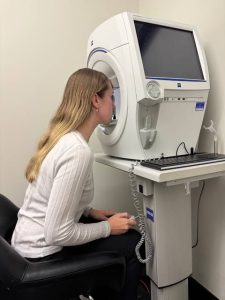
A Visual Field Analyzer is a medical device used to assess the sensitivity and coverage of a patient’s visual field. It maps out the field of vision, detecting any defects or abnormalities, particularly in peripheral vision.

Key Features:

  • Visual Field Testing: Measures the sensitivity of the retina in different locations.
  • Diagnostic Capabilities: Detects conditions like glaucoma, age-related macular degeneration, and other neurological disorders.
  • Variety of Tests: Offers different testing strategies, such as threshold and screening tests.

Types of Visual Field Analyzers:

  • Humphrey Field Analyzer 3 (HFA 3): Considered the gold standard, featuring Guided Progression Analysis and SITA Faster testing.
  • ObjectiveFIELD Analyzer: Uses multifocal pupillographic objective perimetry (mfPOP) for completely objective visual field assessment.
  • PalmScan VF2000: A wearable, portable analyzer with gaze tracking and customizable reports.
  • Easyfield VR: Utilizes virtual reality technology for visual field screenings and threshold exams.
  • Kowa AP-7000: Offers advanced diagnostic capabilities and high accuracy ¹ ² ³ ⁴.

Benefits:

  • Early Detection: Identifies visual field defects and conditions at an early stage.
  • Accurate Results: Provides reliable and reproducible results.
  • Patient Comfort: Some devices offer features like automated verbal instructions and gaze tracking for improved patient experience.

When selecting a Visual Field Analyzer, consider factors such as ⁵:

  • Measurement Accuracy: Look for devices with high accuracy and reliability.
  • Testing Strategies: Choose a device that offers a range of testing options.
  • Patient Comfort: Consider devices with features that improve patient experience.
  • Data Management: Ensure the device allows for easy data storage and analysis.
VISUAL FIELD ANALYSER

A Visual Field Analyzer is a medical device used to assess the sensitivity and coverage of a patient’s visual field. It maps out the field of vision, detecting any defects or abnormalities, particularly in peripheral vision.

Key Features:

  • Visual Field Testing: Measures the sensitivity of the retina in different locations.
  • Diagnostic Capabilities: Detects conditions like glaucoma, age-related macular degeneration, and other neurological disorders.
  • Variety of Tests: Offers different testing strategies, such as threshold and screening tests.

Types of Visual Field Analyzers:

  • Humphrey Field Analyzer 3 (HFA 3): Considered the gold standard, featuring Guided Progression Analysis and SITA Faster testing.
  • ObjectiveFIELD Analyzer: Uses multifocal pupillographic objective perimetry (mfPOP) for completely objective visual field assessment.
  • PalmScan VF2000: A wearable, portable analyzer with gaze tracking and customizable reports.
  • Easyfield VR: Utilizes virtual reality technology for visual field screenings and threshold exams.
  • Kowa AP-7000: Offers advanced diagnostic capabilities and high accuracy ¹ ² ³ ⁴.

Benefits:

  • Early Detection: Identifies visual field defects and conditions at an early stage.
  • Accurate Results: Provides reliable and reproducible results.
  • Patient Comfort: Some devices offer features like automated verbal instructions and gaze tracking for improved patient experience.

When selecting a Visual Field Analyzer, consider factors such as ⁵:

  • Measurement Accuracy: Look for devices with high accuracy and reliability.
  • Testing Strategies: Choose a device that offers a range of testing options.
  • Patient Comfort: Consider devices with features that improve patient experience.
  • Data Management: Ensure the device allows for easy data storage and analysis.
VISUAL FIELD ANALYSER

A Visual Field Analyzer is a medical device used to assess the sensitivity and coverage of a patient’s visual field. It maps out the field of vision, detecting any defects or abnormalities, particularly in peripheral vision.

Key Features:

  • Visual Field Testing: Measures the sensitivity of the retina in different locations.
  • Diagnostic Capabilities: Detects conditions like glaucoma, age-related macular degeneration, and other neurological disorders.
  • Variety of Tests: Offers different testing strategies, such as threshold and screening tests.

Types of Visual Field Analyzers:

  • Humphrey Field Analyzer 3 (HFA 3): Considered the gold standard, featuring Guided Progression Analysis and SITA Faster testing.
  • ObjectiveFIELD Analyzer: Uses multifocal pupillographic objective perimetry (mfPOP) for completely objective visual field assessment.
  • PalmScan VF2000: A wearable, portable analyzer with gaze tracking and customizable reports.
  • Easyfield VR: Utilizes virtual reality technology for visual field screenings and threshold exams.
  • Kowa AP-7000: Offers advanced diagnostic capabilities and high accuracy ¹ ² ³ ⁴.

Benefits:

  • Early Detection: Identifies visual field defects and conditions at an early stage.
  • Accurate Results: Provides reliable and reproducible results.
  • Patient Comfort: Some devices offer features like automated verbal instructions and gaze tracking for improved patient experience.

When selecting a Visual Field Analyzer, consider factors such as ⁵:

  • Measurement Accuracy: Look for devices with high accuracy and reliability.
  • Testing Strategies: Choose a device that offers a range of testing options.
  • Patient Comfort: Consider devices with features that improve patient experience.
  • Data Management: Ensure the device allows for easy data storage and analysis.