Eagleview Eye Clinic

Tag eye Examination

LEGAL BLINDNESS

Legal blindness is a term used to describe a level of visual impairment that meets specific criteria, often used for legal or administrative purposes. The definition may vary slightly depending on the country or region, but generally, it refers to a visual acuity of 20/200 or worse in both eyes with corrective lenses, or a visual field of 20 degrees or less in the better eye.

Key Aspects of Legal Blindness

  • Visual Acuity: A visual acuity of 20/200 means that an individual can see objects clearly at 20 feet away that a person with normal vision can see at 200 feet away.
  • Visual Field: A visual field of 20 degrees or less means that an individual’s field of vision is significantly restricted, making it difficult to see objects or movement outside of a narrow range.
  • Corrective Lenses: The definition of legal blindness takes into account the use of corrective lenses, such as glasses or contacts, to improve visual acuity.

Implications of Legal Blindness

  • Disability Benefits: Individuals who are legally blind may be eligible for disability benefits, such as Social Security Disability Insurance (SSDI) or Supplemental Security Income (SSI).
  • Assistive Technology: Legally blind individuals may use assistive technology, such as screen readers, braille displays, or magnifiers, to access information and perform daily tasks.
  • Rehabilitation Services: Legally blind individuals may be eligible for rehabilitation services, such as orientation and mobility training, to help them adapt to their visual impairment.

Living with Legal Blindness

  • Adaptation: Many individuals who are legally blind adapt to their visual impairment by developing new skills and strategies for daily living.
  • Support: Support from family, friends, and community resources can play a significant role in helping individuals who are legally blind maintain their independence and quality of life.
  • Technology: Advances in technology, such as artificial intelligence and wearable devices, are continually improving the lives of individuals who are legally blind.

.
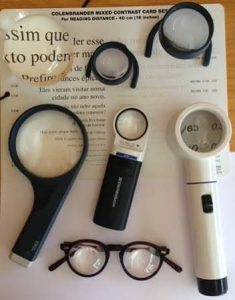
LOW VISION MAGNIFIERS

Low vision magnifiers are devices designed to help individuals with visual impairments maximize their remaining vision. These tools can significantly enhance daily life by providing clear and manageable information.

Types of Low Vision Magnifiers

  • Handheld Magnifying Glasses: Portable and lightweight, these magnifiers are ideal for reading small print, labels, and menus. They come in various magnification strengths (2x to 10x) and are suitable for individuals with macular degeneration, cataracts, or general low vision.
  • Desktop Electronic Magnifiers: These stationary devices project enlarged images onto a screen, allowing users to read documents, view photos, and see objects with enhanced clarity. They’re perfect for extended reading sessions and can help individuals with macular degeneration, diabetic retinopathy, and glaucoma.
  • Wearable Magnifying Glasses: Hands-free magnification makes these glasses ideal for tasks requiring precision, such as hobbies or cooking. They’re customizable and provide consistent magnification, enabling users to engage in everyday activities with confidence.
  • Digital Portable Magnifiers: Compact and lightweight, these devices are perfect for on-the-go reading and writing. They often feature adjustable zoom and color contrast options, making them suitable for individuals with various visual impairments.
  • Electronic Magnifiers: These high-tech devices incorporate digital enhancements like contrast adjustment, brightness control, and text-to-speech features. They’re designed to assist individuals with severe visual impairments and can be used for reading, writing, and other daily tasks.

Benefits of Low Vision Magnifiers

Low vision magnifiers can ¹ ² ³:

  • Enhance visual clarity and readability
  • Increase independence and confidence
  • Facilitate daily tasks, such as reading, writing, and cooking
  • Improve overall quality of life

Popular Brands and Products

Some notable brands and products include ⁴ ⁵ ⁶:

  • Vision Buddy: A wearable magnifying device with a high-resolution display and hands-free design
  • Amigo Portable Low Vision Electronic Magnifier: A simple-to-use device with a 6.5-inch viewing screen and adjustable magnification
  • Pebble HD: A compact and lightweight portable magnifier with a 4.3-inch screen
  • Zoomax Luna: A portable video magnifier with a range of magnification options and high-definition display
  • HumanWare Prodigi: An all-in-one PC with electronic video magnification capabilities

Where to Find Low Vision Magnifiers

You can find low vision magnifiers at specialized stores, online marketplaces, or through low vision services and resource centers. It’s essential to consult with a low vision specialist to determine the best type of magnifier for your specific needs

HOW STRABISMUS AFFECT THE QUALITY OF AN INDIVIDUAL

👓 Strabismus can impact various aspects of an individual’s quality of life, depending on factors like the severity of the condition, age of onset, and how it’s managed.

Potential Effects on Quality of Life

  • Vision and depth perception: Strabismus can affect how well the eyes work together, potentially impacting depth perception, visual clarity, or causing double vision in some cases.
  • Self-esteem and social interactions: Especially in children or teens, noticeable eye misalignment might affect self-confidence or interactions with peers.
  • Daily activities: Depending on the severity, strabismus might impact activities like reading, driving, or tasks requiring precise eye coordination.
  • Treatment and management: Some individuals might need glasses, patches, exercises, or surgery, which can influence daily routines or emotional well-being.

Varied Experiences

  • Adaptation and coping: Many people adapt to strabismus or learn to manage its effects on their daily lives.
  • Treatment outcomes: With proper management or treatment, many individuals with strabismus lead lives with minimal impact on their overall quality of life
TYPES OF STRABISMUS

👓 Strabismus, also known as crossed eyes or squint, is a condition where the eyes don’t align properly. There are several types of strabismus based on the direction of the misalignment and other characteristics.

Types of Strabismus

  • Esotropia: One or both eyes turn inward toward the nose.
  • Exotropia: One or both eyes turn outward away from the nose.
  • Hypertropia: One eye turns upward relative to the other eye.
  • Hypotropia: One eye turns downward relative to the other eye.

Other Classifications

  • Concomitant strabismus: The amount of misalignment is the same in all directions of gaze.
  • Incomitant strabismus: The amount of misalignment varies with the direction of gaze.
  • Intermittent strabismus: The malignment occurs sometimes but not all the time.
OCULAR ALBINISM

Ocular Albinism: Detailed Information

Ocular albinism is a group of inherited conditions affecting the pigmentation of the eyes. Key aspects include:

Characteristics

  • Reduced pigmentation: Mainly affects the iris and retina.
  • Vision problems: Common issues include reduced visual acuity, nystagmus (involuntary eye movements), strabismus, and photophobia (sensitivity to light).
  • Type 1 (OA1): Most common form, typically X-linked inheritance affecting males more severely.

Symptoms and Effects

  • Visual impairment: Range from mild to significant vision loss.
  • Nystagmus and strabismus: Common associated eye movement issues.
  • Photophobia: Sensitivity to light due to lack of pigmentation.

Genetics and Diagnosis

  • Inheritance: Usually X-linked for OA1, affecting males primarily.
  • Diagnosis: Often based on clinical findings like iris transillumination defects and visual issues.

Management

  • Visual aids: Glasses or contact lenses may help.
  • Low vision support: Services can assist with daily challenges.
  • Protection from sunlight: Due to photophobia.

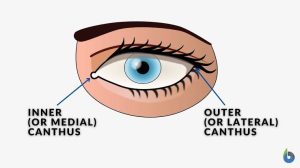
LATERAL CANTHUS

The lateral canthus is a part of the eye’s anatomy. Key features:

  1. Location: The outer corner of the eye where the upper and lower eyelids meet.
  2. Function:
    • Helps with eyelid stability and movement.
    • Contributes to the overall shape and function of the eyelids.
  3. Clinical significance:
    • Can be involved in conditions like lateral canthal tendon laxity or injuries.
    • Sometimes a focus in oculoplastic surgery for cosmetic or functional reasons.

The lateral canthus is one of the anatomical landmarks of the eye.

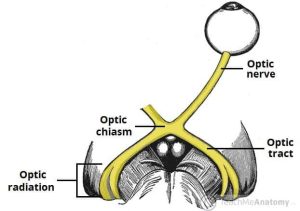
OPTIC CHIASM

The optic chiasm is a part of the visual pathway. Key features:

  1. Location: Located at the base of the brain, above the pituitary gland.
  2. Function:
    • Nerve fibers from the nasal part of each retina cross over (decussate) here.
    • Allows for integration of visual information from both eyes.
  3. Importance:
    • Plays a crucial role in binocular vision and visual field processing.
    • Lesions or damage to the optic chiasm can cause specific visual field defects (like bitemporal hemianopia).

The optic chiasm is a key structure in the visual pathway.

ANTERIOR CHAMBER ANGLE

The anterior chamber angle is a critical area in the eye. Key features:

  1. Location: The angle formed by the junction of the iris and cornea in the anterior chamber.
  2. Importance:
    • Contains the trabecular meshwork, which drains aqueous humor
    • Plays a key role in regulating intraocular pressure
  3. Clinical significance: Narrowing or closure of the anterior chamber angle can lead to angle-closure glaucoma.

The anatomy of the anterior chamber angle is important for understanding glaucoma and other ocular conditions.

TRABECULAE MESHWORK

The trabecular meshwork is a key structure in the eye. Key features:

  1. Location: Located near the base of the iris, in the angle of the anterior chamber.
  2. Function:
    • Drains aqueous humor from the eye
    • Regulates intraocular pressure by controlling outflow of aqueous humor
  3. Importance: Dysfunction or blockage of the trabecular meshwork can lead to increased intraocular pressure and conditions like glaucoma.

The trabecular meshwork plays a crucial role in maintaining healthy intraocular pressure.

OPTIC NERVES

The optic nerve, also known as cranial nerve II, plays a vital role in the visual pathway. Here’s a detailed description:

Structure:

  1. Origin: The optic nerve originates from the ganglion cells of the retina.
  2. Composition: It’s composed of approximately 1.2 million nerve fibers, which are the axons of retinal ganglion cells.
  3. Intraocular and extraocular portions: The optic nerve has both intraocular (within the eye) and extraocular (outside the eye) portions.

Function:

  1. Transmission of visual information: The optic nerve transmits electrical signals from the retina to the brain, enabling us to perceive and interpret visual stimuli.
  2. Visual pathway: The optic nerve carries visual information from the eye to the optic chiasm, where the signals are combined and transmitted to the lateral geniculate nucleus, and eventually to the visual cortex.

Key features:

  1. Myelination: The optic nerve is myelinated, which enables faster transmission of electrical signals.
  2. Blood supply: The optic nerve receives its blood supply from the ophthalmic artery and its branches.

Clinical significance:

  1. Optic neuritis: Inflammation of the optic nerve can cause vision loss, pain, and impaired color vision.
  2. Glaucoma: Increased intraocular pressure can damage the optic nerve, leading to progressive vision loss.
  3. Optic nerve damage: Trauma, tumors, or other conditions can damage the optic nerve, resulting in vision loss or blindness.

The optic nerve plays a crucial role in enabling us to see and interpret the world around us.